# Google Colab: install packages not included in the default environment
try:
    import google.colab
    !pip install statsmodels seaborn -q
except ImportError:
    pass  # Local environment — packages already installed
This notebook examines absolute \(\beta\)-convergence in nighttime luminosity across 520 Indian districts (1996–2010). We regress per capita luminosity growth on initial luminosity levels and visualize the relationship in an annotated scatterplot. This analysis corresponds to the first set of results discussed in the main manuscript.
1 Setup
In [4]:
In [5]:
# Setup
import numpy as np
import pandas as pd
import matplotlib.pyplot as plt
import seaborn as sns
import statsmodels.formula.api as smf

import warnings
warnings.filterwarnings("ignore")
2 Data
We use district-level radiance-calibrated nighttime lights data from the DMSP-OLS satellites, covering 520 districts.
In [7]:
# Load dataset (local copy first, else download from GitHub)
import os
import urllib.request

fname = "india520.dta"
url = "https://raw.githubusercontent.com/quarcs-lab/project2025s-py/main/data/" + fname
local = os.path.join("..", "data", fname)
path = local if os.path.exists(local) else fname
if path == fname and not os.path.exists(fname):
    urllib.request.urlretrieve(url, fname)
data = pd.read_stata(path)
print("Districts: {}".format(len(data)))
Districts: 5203 Convergence regression
A negative slope on initial luminosity indicates \(\beta\)-convergence: districts with lower initial luminosity grew faster over the period.
In [9]:
# Basic OLS Regression
model1 = smf.ols("light_growth96_10rcr_cap ~ log_light96_rcr_cap", data=data).fit()
print(model1.summary())
OLS Regression Results
====================================================================================
Dep. Variable: light_growth96_10rcr_cap R-squared: 0.255
Model: OLS Adj. R-squared: 0.253
Method: Least Squares F-statistic: 177.0
Date: Thu, 27 Aug 2026 Prob (F-statistic): 5.89e-35
Time: 15:38:15 Log-Likelihood: 974.41
No. Observations: 520 AIC: -1945.
Df Residuals: 518 BIC: -1936.
Df Model: 1
Covariance Type: nonrobust
=======================================================================================
coef std err t P>|t| [0.025 0.975]
---------------------------------------------------------------------------------------
Intercept -0.0723 0.007 -9.790 0.000 -0.087 -0.058
log_light96_rcr_cap -0.0199 0.001 -13.306 0.000 -0.023 -0.017
==============================================================================
Omnibus: 47.400 Durbin-Watson: 1.995
Prob(Omnibus): 0.000 Jarque-Bera (JB): 140.318
Skew: 0.408 Prob(JB): 3.39e-31
Kurtosis: 5.411 Cond. No. 23.2
==============================================================================
Notes:
[1] Standard Errors assume that the covariance matrix of the errors is correctly specified.In [10]:
# Compute regression model for scatterplot annotation
model = smf.ols("light_growth96_10rcr_cap ~ log_light96_rcr_cap", data=data).fit()
slope = round(model.params["log_light96_rcr_cap"], 3)
rsq   = round(model.rsquared, 3)
The \(\beta\) coefficient implies an annual speed of convergence \(\lambda = -\ln(1 + \beta T)/T\) (Barro & Sala-i-Martin), where \(T = 14\) years (1996–2010) and the dependent variable is the average annual growth rate, together with a half-life \(\ln(2)/\lambda\) (the time to close half the gap to the steady state).
In [12]:
# Implied annual speed of convergence and half-life (Barro & Sala-i-Martin)
T = 14  # 1996-2010; dependent variable is the average annual growth rate
beta = model.params["log_light96_rcr_cap"]
speed = -np.log(1 + beta * T) / T   # annual convergence speed (lambda)
half_life = np.log(2) / speed       # years to close half the gap
print("Convergence coefficient (beta): {:.4f}".format(beta))
print("Annual speed of convergence:    {:.2%}".format(speed))
print("Implied half-life:              {:.1f} years".format(half_life))
Convergence coefficient (beta): -0.0199
Annual speed of convergence: 2.33%
Implied half-life: 29.7 years4 Sigma convergence
\(\beta\)-convergence is necessary but not sufficient for a fall in the cross-district dispersion of luminosity. We therefore check \(\sigma\)-convergence directly, comparing the standard deviation of log per-capita luminosity at the two endpoints. The 2010 value is reconstructed from the 1996 level and the average annual growth rate, which is how the dependent variable is defined.
In [14]:
# Sigma convergence: cross-district dispersion of log per-capita luminosity
sd96 = data["log_light96_rcr_cap"].std()
sd10 = (data["log_light96_rcr_cap"] + T * data["light_growth96_10rcr_cap"]).std()
print("SD of log luminosity per capita, 1996: {:.4f}".format(sd96))
print("SD of log luminosity per capita, 2010: {:.4f}".format(sd10))
print("Change:                                {:+.4f} ({:+.1%})".format(sd10 - sd96, sd10 / sd96 - 1))
SD of log luminosity per capita, 1996: 1.0934
SD of log luminosity per capita, 2010: 0.9454
Change: -0.1481 (-13.5%)5 Convergence scatterplot
The scatterplot below visualizes the convergence relationship. Outlier districts are labeled to highlight cases that deviate notably from the overall trend—either bright districts that declined or dim districts that grew unusually fast.
In [16]:
# Identify outlier districts for labeling
mask = (
    ((data["log_light96_rcr_cap"] > -3) & (data["light_growth96_10rcr_cap"] < 0))
    | ((data["log_light96_rcr_cap"] < -7) & (data["light_growth96_10rcr_cap"] > 0.2))
)
outliers = data[mask]

# Annotated scatterplot
fig, ax = plt.subplots(figsize=(8, 6))
sns.regplot(
    data=data,
    x="log_light96_rcr_cap",
    y="light_growth96_10rcr_cap",
    ci=95,
    scatter_kws={"alpha": 0.5, "color": "steelblue"},
    line_kws={"color": "black", "linewidth": 0.8},
    ax=ax,
)

# Label outlier districts
for _, r in outliers.iterrows():
    ax.annotate(
        r["district"],
        xy=(r["log_light96_rcr_cap"], r["light_growth96_10rcr_cap"]),
        xytext=(0, 6),
        textcoords="offset points",
        ha="center",
        fontsize=8,
        bbox=dict(boxstyle="round,pad=0.3", fc="white", ec="gray", alpha=0.7),
    )

# Slope / R-squared / speed / half-life annotation box (top-right corner)
annotation = "Slope = {}\nR² = {}\nSpeed = {:.1%} per year\nHalf-life = {:.1f} years".format(
    slope, rsq, speed, half_life
)
ax.annotate(
    annotation,
    xy=(0.97, 0.97),
    xycoords="axes fraction",
    ha="right",
    va="top",
    fontsize=11,
    bbox=dict(boxstyle="round,pad=0.4", fc="white", ec="black", alpha=0.9),
)

ax.set_xlabel("Log of luminosity per capita in 1996")
ax.set_ylabel("Growth of luminosity per capita 1996-2010")
sns.despine(ax=ax)
plt.tight_layout()
plt.show()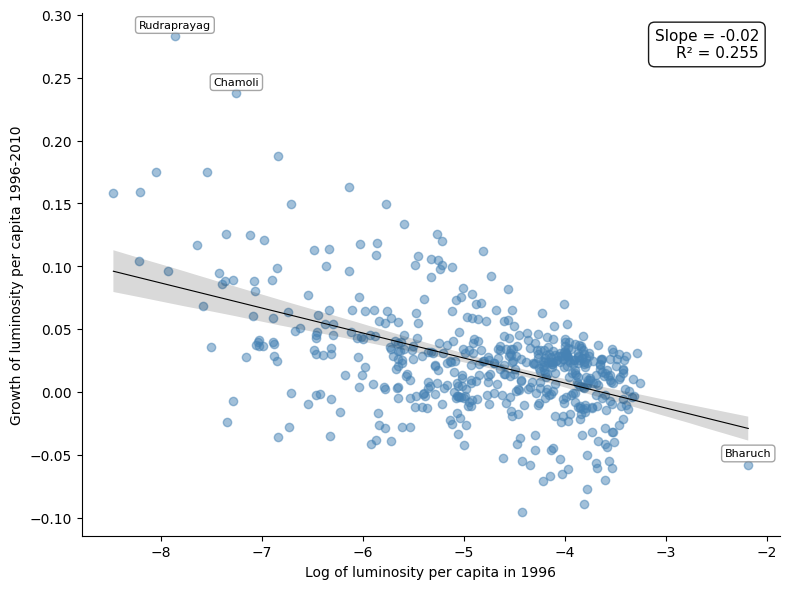
Notes: Each point represents one of the 520 districts. The regression line shows the estimated beta-convergence relationship, and the annotation reports its slope, the R-squared, the implied annual speed of convergence, and the half-life. Outlier districts are labeled.
Source: Data from Chanda and Kabiraj (2020). See Regional convergence notebook for source code.