# Google Colab: install packages not included in the default environment
try:
    import google.colab
    !pip install geopandas libpysal spreg -q
except ImportError:
    pass  # Local environment — packages already installed
This notebook re-evaluates the preferred Model 4 (conditional Spatial Durbin Model with state fixed effects) under a range of alternative spatial weight matrices, as a robustness check on the spillover results reported in the main manuscript. The baseline analysis uses a 6-nearest-neighbor (6NN) row-standardized matrix; here we re-estimate the same model with:
- 4 nearest neighbors and 8 nearest neighbors (denser/sparser k-NN graphs);
- Queen and Rook contiguity (shared-boundary neighbors);
- Inverse distance (\(w_{ij} \propto 1/d_{ij}\)) and inverse distance squared (\(w_{ij} \propto 1/d_{ij}^2\)), applied within a distance band.
All matrices are row-standardized. For each, we report the Direct, Indirect, and Total spatial impacts of initial luminosity (full LeSage–Pace method, with Monte-Carlo standard errors) and the model AIC, alongside the 6NN baseline.
In [3]:
1 1. Setup
In [5]:
# Configuration
import os
import math
import warnings
import urllib.request
from contextlib import redirect_stdout

import numpy as np
import pandas as pd
import geopandas as gpd
import matplotlib.pyplot as plt
from libpysal.weights import KNN, Queen, Rook, DistanceBand
from libpysal.weights.util import attach_islands, min_threshold_distance
from spreg import ML_Lag

warnings.filterwarnings("ignore")
np.random.seed(20250620)

DV   = "light_growth96_10rcr_cap"   # dependent variable: per-capita NTL growth 1996-2010
XKEY = "log_light96_rcr_cap"        # main regressor: initial (log) per-capita NTL, 1996
KEY  = "statedist"                  # 1:1 merge key between geometry and data
N_MC = 10_000                       # Monte-Carlo draws for impact inference
PROJ = 7755                         # EPSG:7755 (India NSF LCC, metres) for distance-based weights

CONTROLS = [
    "suit_mean_snd", "rain_mean_snd", "mala_mean_snd", "temp_mean_snd",
    "rug_mean_snd", "distance", "latitude", "rur_percent96_rcr",
    "log_tot_density_rcr", "sc_percent96", "st_percent96", "workp_percent96",
    "lit_percent96", "higheredu_percent96", "elechh_percent96", "log_puccaroads",
]

RAW = "https://raw.githubusercontent.com/quarcs-lab/project2025s-py/main/data"
In [6]:
# Load data (local ../data first, else download from the public repo)
def _resolve(fname):
    for cand in (os.path.join("..", "data", fname), os.path.join("data", fname), fname):
        if os.path.exists(cand):
            return cand
    url = "{}/{}".format(RAW, fname)
    print("Downloading {} from {}".format(fname, url))
    urllib.request.urlretrieve(url, fname)
    return fname


gdf = gpd.read_file(_resolve("india520.geojson"))
dta = pd.read_stata(_resolve("india520.dta"))
keep = [KEY, DV, XKEY, "state"] + CONTROLS
m = gdf[[KEY, "geometry"]].merge(dta[keep], on=KEY)
m = gpd.GeoDataFrame(m, geometry="geometry", crs=gdf.crs)
assert len(m) == 520, "expected 520 districts, got {}".format(len(m))

y = m[[DV]].values
fe = pd.get_dummies(m["state"], prefix="st", drop_first=True).astype(float)
# Model 4 design: key regressor + 16 controls + state fixed effects
Xdf4 = pd.concat([m[[XKEY] + CONTROLS], fe], axis=1)
print("Districts: {} | Model 4 regressors (excl. constant): {}".format(len(m), Xdf4.shape[1]))
Districts: 520 | Model 4 regressors (excl. constant): 442 2. Build the alternative weight matrices
All weights are row-standardized. k-NN weights use the same lat/lon centroid basis as the baseline 6NN, so that the 6NN row reproduces Table 1. Contiguity islands (Queen: 1, Rook: 2) are attached to their single nearest neighbor. Inverse-distance weights apply \(1/d^{p}\) within a distance band — the smallest threshold that leaves no district isolated — with centroid distances measured in a metric projection (EPSG:7755). Banding keeps the weights local and avoids the near-collinearity (every row tending to a global average) that destabilizes dense all-pairs distance weights.
In [8]:
def w_knn(g, k):
    w = KNN.from_dataframe(g, k=k)            # lat/lon centroids, matches the baseline
    w.transform = "r"
    return w


def w_contig(g, kind):
    w = (Queen if kind == "queen" else Rook).from_dataframe(g, use_index=False, silence_warnings=True)
    if w.islands:                              # attach each island to its nearest neighbor
        w = attach_islands(w, KNN.from_dataframe(g, k=1), silence_warnings=True)
    w.transform = "r"
    return w


def w_invdist(g, power):
    cent = g.to_crs(PROJ).geometry.centroid    # metric CRS for accurate distances
    xy = np.c_[cent.x.values, cent.y.values]
    th = min_threshold_distance(xy)            # smallest band that leaves no district isolated
    w = DistanceBand(xy, threshold=th, alpha=-float(power), binary=False, silence_warnings=True)
    w.transform = "r"
    return w


WMATS = [
    ("4 nearest neighbors",       w_knn(m, 4)),
    ("6 nearest neighbors (base)", w_knn(m, 6)),
    ("8 nearest neighbors",       w_knn(m, 8)),
    ("Queen contiguity",          w_contig(m, "queen")),
    ("Rook contiguity",           w_contig(m, "rook")),
    ("Inverse distance",          w_invdist(m, 1)),
    ("Inverse distance squared",  w_invdist(m, 2)),
]
for name, w in WMATS:
    print("{:28s} mean neighbours = {:.2f}".format(name, w.mean_neighbors))
4 nearest neighbors mean neighbours = 4.00
6 nearest neighbors (base) mean neighbours = 6.00
8 nearest neighbors mean neighbours = 8.00
Queen contiguity mean neighbours = 5.19
Rook contiguity mean neighbours = 5.05
Inverse distance mean neighbours = 14.17
Inverse distance squared mean neighbours = 14.173 3. Re-estimate Model 4 under each weight matrix
We reuse the manuscript’s estimation logic: a Spatial Durbin Model via ML_Lag(slx_lags=1), with Direct/Indirect/Total impacts of initial luminosity computed by the full (LeSage–Pace) decomposition \(S_r(W) = (I-\rho W)^{-1}(\beta_r I + \theta_r W)\), and Monte-Carlo standard errors.
In [10]:
def stars(est, se):
    if se <= 0 or not np.isfinite(se):
        return ""
    z = abs(est / se)
    p = 2 * (1 - 0.5 * (1 + math.erf(z / math.sqrt(2))))
    return "***" if p < 0.01 else "**" if p < 0.05 else "*" if p < 0.10 else ""


def full_rank_lag_mask(Xv, Wd):
    n, k = Xv.shape
    WX = Wd @ Xv
    design = np.hstack([np.ones((n, 1)), Xv])
    rank = np.linalg.matrix_rank(design)
    mask = [True] * k
    for j in range(k):
        test = np.hstack([design, WX[:, [j]]])
        if np.linalg.matrix_rank(test) > rank:
            design, rank = test, rank + 1
        else:
            mask[j] = False
    return mask


def run_sdm(y, Xdf, w):
    """SDM (full LeSage-Pace impacts) of the key regressor for one weight matrix.

    Direct = adi*b + awi*g, Total = (b+g)/(1-rho), Indirect = Total - Direct,
    where adi = n^-1 tr[(I-rho W)^-1] and awi = n^-1 tr[(I-rho W)^-1 W], both
    from the eigenvalues of W. The awi*g term is the own-district share of the
    spatially lagged regressor; `spreg` omits it and assigns the whole SLX
    coefficient to the indirect effect. Monte-Carlo SEs recompute both
    multipliers for each rho draw.
    """
    Wd = w.full()[0]
    eigs = np.linalg.eigvals(Wd)
    Xv = Xdf.astype(float).values
    mask = full_rank_lag_mask(Xv, Wd)
    assert mask[0], "the key regressor's spatial lag must be retained"
    slx_vars = "All" if all(mask) else mask
    with redirect_stdout(open(os.devnull, "w")):
        mod = ML_Lag(y=y, x=Xv, w=w, slx_lags=1, slx_vars=slx_vars, spat_impacts="full")

    b = mod.betas.flatten()
    k = Xv.shape[1]
    i_b, i_g, i_r = 1, 1 + k, len(b) - 1
    rho = b[i_r]

    def adi(R):
        R = np.atleast_1d(np.asarray(R, dtype=float))
        return (1.0 / (1.0 - np.outer(R, eigs))).real.mean(axis=1)

    def awi(R):
        R = np.atleast_1d(np.asarray(R, dtype=float))
        return (eigs / (1.0 - np.outer(R, eigs))).real.mean(axis=1)

    direct = adi(rho)[0] * b[i_b] + awi(rho)[0] * b[i_g]
    total = (b[i_b] + b[i_g]) / (1 - rho)
    indirect = total - direct

    draws = np.random.multivariate_normal(b, mod.vm, size=N_MC)
    D, G, R = draws[:, i_b], draws[:, i_g], draws[:, i_r]
    Deff = adi(R) * D + awi(R) * G
    T = (D + G) / (1 - R)
    I = T - Deff
    return {
        "direct": direct, "direct_se": Deff.std(),
        "indirect": indirect, "indirect_se": I.std(),
        "total": total, "total_se": T.std(),
        "aic": mod.aic, "rho": rho,
    }


np.random.seed(20250620)
res = {}
for name, w in WMATS:
    res[name] = run_sdm(y, Xdf4, w)
    print("{:28s} done (rho={:.3f})".format(name, res[name]["rho"]))
4 nearest neighbors done (rho=0.190)
6 nearest neighbors (base) done (rho=0.199)
8 nearest neighbors done (rho=0.162)
Queen contiguity done (rho=0.227)
Rook contiguity done (rho=0.231)
Inverse distance done (rho=-0.002)
Inverse distance squared done (rho=0.157)4 4. Robustness table
In [12]:
from IPython.display import Markdown


# A real minus (U+2212), not the ASCII hyphen: LaTeX may break a line at a
# hyphen, which strands the sign on its own line in a narrow table column.
MINUS = "\u2212"


def _num(x, nd=3):
    return "{:.{}f}".format(x, nd).replace("-", MINUS)


def _cell(est, se):
    return "{}{}".format(_num(est), stars(est, se))


def _se(se):
    return "({})".format(_num(se))


# Standard errors go on their own row rather than in a <br> inside the cell:
# pandoc drops <br> when it writes LaTeX, which concatenated the estimate and
# its standard error into one over-wide cell. This also matches tbl-models.
rows = [
    "| Weight matrix | Direct | Indirect | Total | AIC |",
    "|---------------|--------|----------|-------|-----|",
]
for name, _ in WMATS:
    r = res[name]
    rows.append("| {} | {} | {} | {} | {} |".format(
        name,
        _cell(r["direct"], r["direct_se"]),
        _cell(r["indirect"], r["indirect_se"]),
        _cell(r["total"], r["total_se"]),
        _num(r["aic"], 0),
    ))
    rows.append("| | {} | {} | {} | |".format(
        _se(r["direct_se"]), _se(r["indirect_se"]), _se(r["total_se"]),
    ))
Markdown("\n".join(rows))
In [13]:
| Weight matrix | Direct | Indirect | Total | AIC |
|---|---|---|---|---|
| 4 nearest neighbors | −0.024*** | −0.008 | −0.032*** | −2468 |
| (0.002) | (0.005) | (0.006) | ||
| 6 nearest neighbors (base) | −0.025*** | −0.012* | −0.037*** | −2501 |
| (0.002) | (0.007) | (0.007) | ||
| 8 nearest neighbors | −0.025*** | −0.011 | −0.036*** | −2485 |
| (0.002) | (0.008) | (0.008) | ||
| Queen contiguity | −0.025*** | −0.010** | −0.035*** | −2463 |
| (0.002) | (0.005) | (0.005) | ||
| Rook contiguity | −0.025*** | −0.009** | −0.034*** | −2469 |
| (0.002) | (0.004) | (0.005) | ||
| Inverse distance | −0.025*** | −0.016** | −0.041*** | −2486 |
| (0.002) | (0.007) | (0.008) | ||
| Inverse distance squared | −0.025*** | −0.012* | −0.037*** | −2485 |
| (0.002) | (0.006) | (0.006) |
5 5. Summary figure
In [15]:
names = [n for n, _ in WMATS]
ypos = np.arange(len(names))[::-1]   # top-to-bottom in listed order
effects = [("direct", "Direct", "#2c7fb8"), ("indirect", "Indirect", "#d95f0e"), ("total", "Total", "#31a354")]

fig, axes = plt.subplots(1, 3, figsize=(12, 4.2), sharey=True)
for ax, (key, label, color) in zip(axes, effects):
    est = np.array([res[n][key] for n in names])
    se = np.array([res[n][key + "_se"] for n in names])
    ax.errorbar(est, ypos, xerr=1.96 * se, fmt="o", color=color, ecolor=color,
                elinewidth=1.5, capsize=3, markersize=6)
    ax.axvline(0, color="0.6", lw=0.8)
    base = res["6 nearest neighbors (base)"][key]
    ax.axvline(base, color=color, ls="--", lw=1.0, alpha=0.7)
    ax.set_title("{} effect".format(label))
    ax.set_xlabel("Impact of initial luminosity")
axes[0].set_yticks(ypos)
axes[0].set_yticklabels(names)
fig.tight_layout()
plt.show()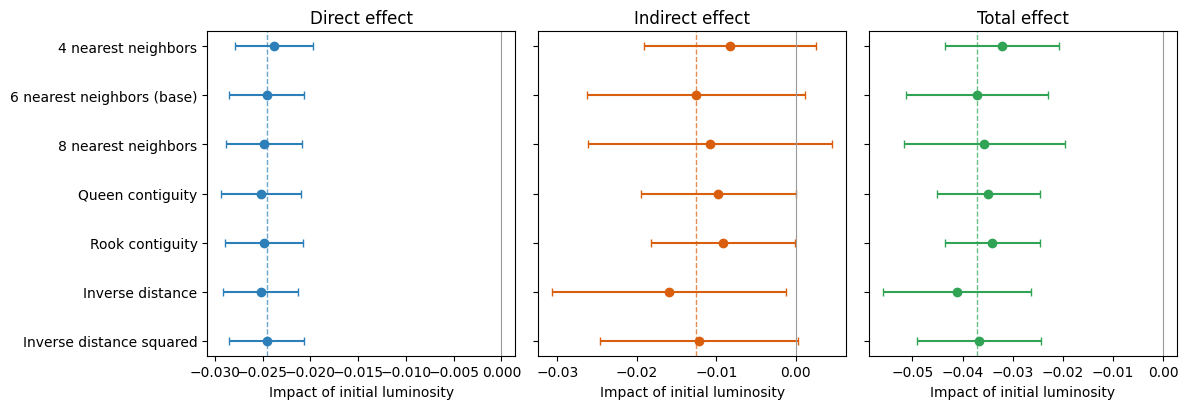
The estimates are reported alongside the 6NN baseline (dashed lines), so the figure shows directly whether the sign, magnitude, and significance of the convergence spillovers are robust to the choice of spatial weight matrix.