---
title: "Matrix Completion and Interactive Fixed Effects"
---
## When parallel trends isn't enough
Chapter 9 squeezed every drop of usable signal out of the
Callaway-Sant'Anna minimum-wage panel under one identifying
assumption: **parallel trends**. Conditional or unconditional, with
or without never-treated counties, with or without anticipation
slack, with Rambachan-Roth bounds on top — the assumption is always
that, absent treatment, the trajectory of the treated counties would
have moved *in parallel* with the untreated.
What if it would not have? Counties select into raising the minimum
wage non-randomly. They are not a random subset of the country in
the time-varying dimension either: industry mix, demographics, and
local growth trends all shape both treatment timing and outcome
paths. Two counties can share an industry-mix-driven trajectory that
TWFE never absorbs — and so cannot net out.
This chapter relaxes parallel trends in a specific way. We model the
counterfactual outcome as a **factor structure**:
$$Y_{it}(0) \;=\; \alpha_i + \xi_t + \lambda_i' f_t + \varepsilon_{it}.$$
Each unit $i$ has a loading vector $\lambda_i$; each period a factor
vector $f_t$. Their interaction $\lambda_i' f_t$ encodes
time-varying unobserved heterogeneity that no county or year fixed
effect can absorb. Two views of the same object give two estimators
[@liu2024practical]:
- **Interactive Fixed Effects (IFEct)** [@bai2009panel; @xu2017generalized]
treats $(\alpha, \xi, \Lambda, F)$ as parameters to be estimated on
control observations, then imputes $Y_{it}(0)$ on treated cells.
- **Matrix Completion (MC)** [@athey2021matrix] reframes the same
problem as filling missing entries of the implicit $Y(0)$ matrix:
mask the treated cells, then complete via nuclear-norm-regularised
SVD.
Yiqing Xu's `fect` package implements both with a common API and a
common counterfactual-plot diagnostic. By chapter's end we line up
its IFE and MC estimates next to the Callaway-Sant'Anna ATT from
chapter 9 on the same panel — three estimands, three identifying
assumptions, one substantive question.
## Setup and data
```{r}
#| label: setup
#| message: false
#| warning: false
library(tidyverse)
library(fect)
library(panelView)
library(did)
library(patchwork)
source("R/table_helpers.R")

set.seed(42)

knitr::opts_chunk$set(dev.args = list(bg = "transparent"))

theme_set(
  theme_minimal(base_size = 12) +
    theme(
      plot.background  = element_rect(fill = "transparent", color = NA),
      panel.background = element_rect(fill = "transparent", color = NA),
      panel.grid.major = element_line(color = "#94a3b8", linewidth = 0.25),
      panel.grid.minor = element_line(color = "#94a3b8", linewidth = 0.15),
      text             = element_text(color = "#94a3b8"),
      axis.text        = element_text(color = "#94a3b8"),
      strip.text       = element_text(color = "#94a3b8"),
      legend.text      = element_text(color = "#94a3b8")
    )
)
```
We work from the same `cs_minwage.rds` panel as chapter 9, but with
one small adjustment: factor-based estimators need **at least as
many pre-treatment periods per cohort as the number of factors they
try to fit**. Chapter 9's 2003-2007 window leaves the 2004 cohort
with only one pre-period, which would force `min.T0 = 1` and cap
the rank at zero — collapsing IFEct back to TWFE. So we widen the
pre-treatment window by two years to 2001-2007; everything else
(cohort filter, region drop, treatment indicator) is identical.
```{r}
#| label: data-load
mw_raw <- readRDS("data/cs_minwage.rds") |> as_tibble()

mw <- mw_raw |>
  filter(G %in% c(0, 2004, 2006, 2007), region != "1") |>
  filter(G != 2007, year >= 2001) |>
  mutate(D = as.integer(year >= G & G != 0))

dim(mw)
```
```{r}
#| label: tbl-cohorts
#| tbl-cap: "Cohorts in the 2001-2007 working panel. $G = 0$ is the never-treated control pool; the two treated cohorts have 3 and 5 pre-treatment years respectively."
mw |>
  filter(year == 2001) |>
  count(G, name = "counties") |>
  mutate(`Pre-periods` = case_when(
    G == 0    ~ NA_integer_,
    G == 2004 ~ 3L,
    G == 2006 ~ 5L
  )) |>
  rename(`Cohort (G)` = G) |>
  gt_pretty()
```
The outcome `lemp` (log teen employment) and the treatment indicator
`D` (1 once a county's state has raised its minimum wage above the
federal floor, 0 otherwise) line up with chapter 9's definitions.
## Visualising the panel
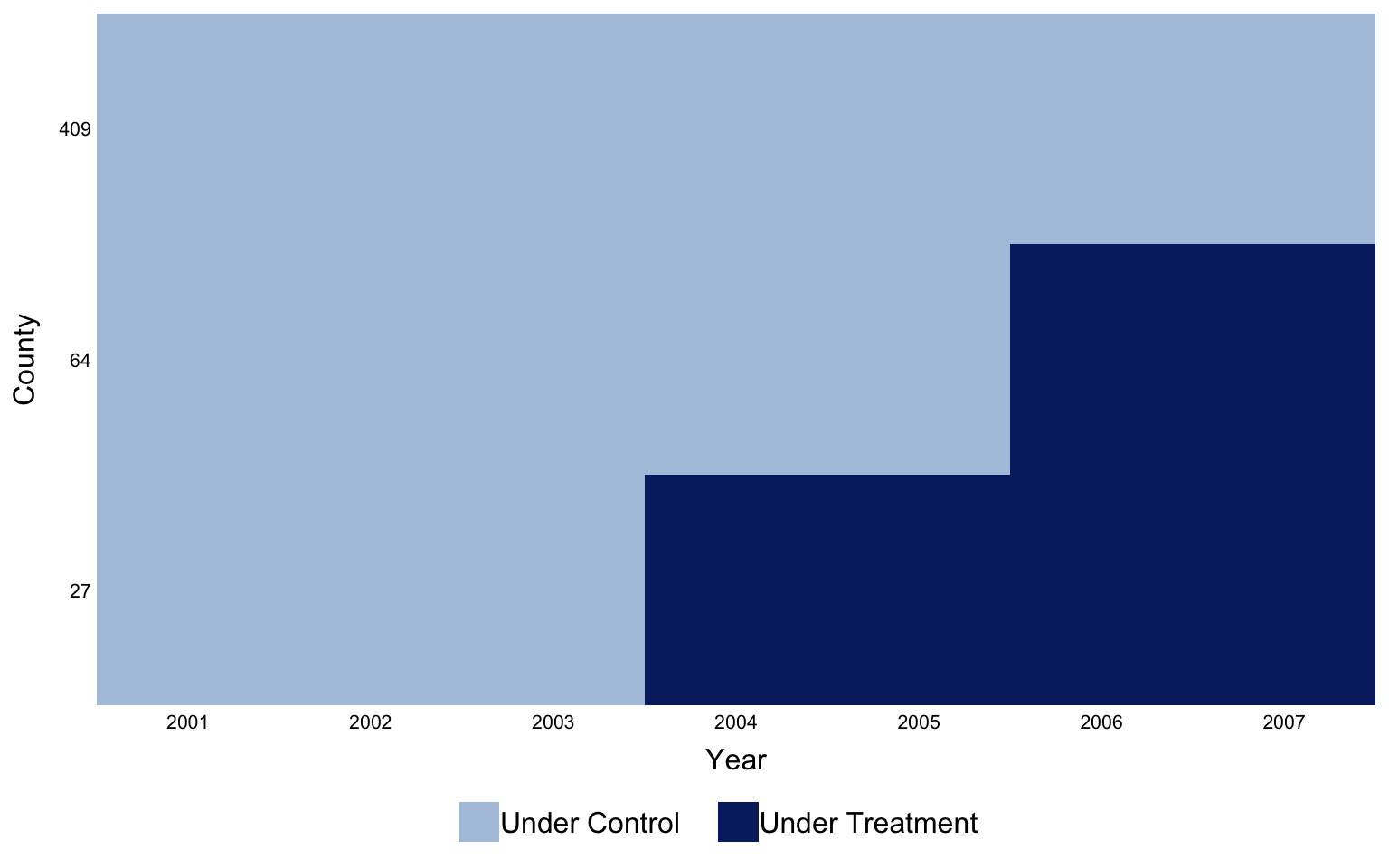
`panelView` is the natural opener for any FECT workflow. It draws
units on the vertical axis and time on the horizontal, coloured by
treatment status, so the staggered-adoption structure of the panel
is immediate.
```{r}
#| label: fig-panelview
#| fig-cap: "Treatment status by county and year. The two horizontal bands of pink are the 2004 and 2006 cohorts; the wide grey band underneath is the never-treated $G = 0$ control pool. The visible step in the pink rows is the staggered adoption that breaks TWFE."
#| fig-width: 8
#| fig-height: 5
panelview(data = as.data.frame(mw), formula = lemp ~ D,
          index = c("id", "year"),
          xlab = "Year", ylab = "County",
          main = "", legendOff = FALSE,
          theme.bw = TRUE,
          background = "transparent")
```
## The factor model of counterfactuals
Both estimators target the same object — the counterfactual matrix
$Y(0)$ of what each county's log teen employment *would* have been
absent any minimum-wage increase. Where they differ is in how they
restrict that matrix.
**IFEct** imposes the explicit factor decomposition $Y_{it}(0) =
\alpha_i + \xi_t + \lambda_i' f_t + \varepsilon_{it}$, fits
$(\alpha, \xi, \Lambda, F)$ on the **control** observations only,
and uses those estimates to impute $Y_{it}(0)$ for treated
cells. The choice of $r$ — how many factors — is made by
cross-validation: hold out small blocks of control cells, refit,
score by MSPE on the held-out cells [@xu2017generalized;
@liu2024practical].
**MC** does not write the factor model down. It assumes only that
the matrix of $Y(0)$ outcomes is **approximately low rank**, then
completes it by minimising a Frobenius-norm fit penalty *plus* a
nuclear-norm penalty on the singular values. Nuclear-norm
regularisation is the convex relaxation of "low rank" the same way
$\ell_1$ is the convex relaxation of "sparse" [@athey2021matrix].
The penalty weight $\lambda$ plays the role of $r$ and is again
chosen by cross-validation.
The key practical implication: both methods bake in
**unit-specific time trends** automatically, without you having to
specify which units or which trend shapes. Parallel trends becomes
a special case (the $r = 0$ corner of IFEct, or the limit
$\lambda \to \infty$ in MC) rather than an assumption.
## Estimating with FECT
The two fits below cap the rank grid at $r \in \{0, 1, 2\}$. With
only 7 calendar years and 3 pre-periods on the shorter cohort, any
$r$ larger than that would be statistical fantasy.
The bootstrap (`nboots = 200`) is the dominant cost; both chunks
cache to `_freeze/` so subsequent renders skip them.
```{r}
#| label: fit-ife
#| message: false
#| warning: false
out_ife <- fect(
  lemp ~ D, data = as.data.frame(mw),
  index    = c("id", "year"),
  method   = "ife",
  force    = "two-way",
  CV       = TRUE,
  r        = 0:2,
  min.T0   = 2,
  cv.nobs  = 2,
  cv.donut = 0,
  se       = TRUE,
  nboots   = 200,
  parallel = TRUE,
  seed     = 42
)
```
```{r}
#| label: fit-mc
#| message: false
#| warning: false
out_mc <- fect(
  lemp ~ D, data = as.data.frame(mw),
  index    = c("id", "year"),
  method   = "mc",
  force    = "two-way",
  CV       = TRUE,
  min.T0   = 2,
  cv.nobs  = 2,
  cv.donut = 0,
  se       = TRUE,
  nboots   = 200,
  parallel = TRUE,
  seed     = 42
)
```
```{r}
#| label: tbl-cv
#| tbl-cap: "Hyperparameters selected by cross-validation. IFEct picks the number of latent factors $r$; MC picks the nuclear-norm penalty weight $\\lambda$."
tibble(
  Method            = c("IFEct", "MC"),
  `CV-selected`     = c(paste0("r = ", unname(out_ife$r.cv)),
                        sprintf("lambda = %.4f", out_mc$lambda.cv))
) |>
  gt_pretty()
```
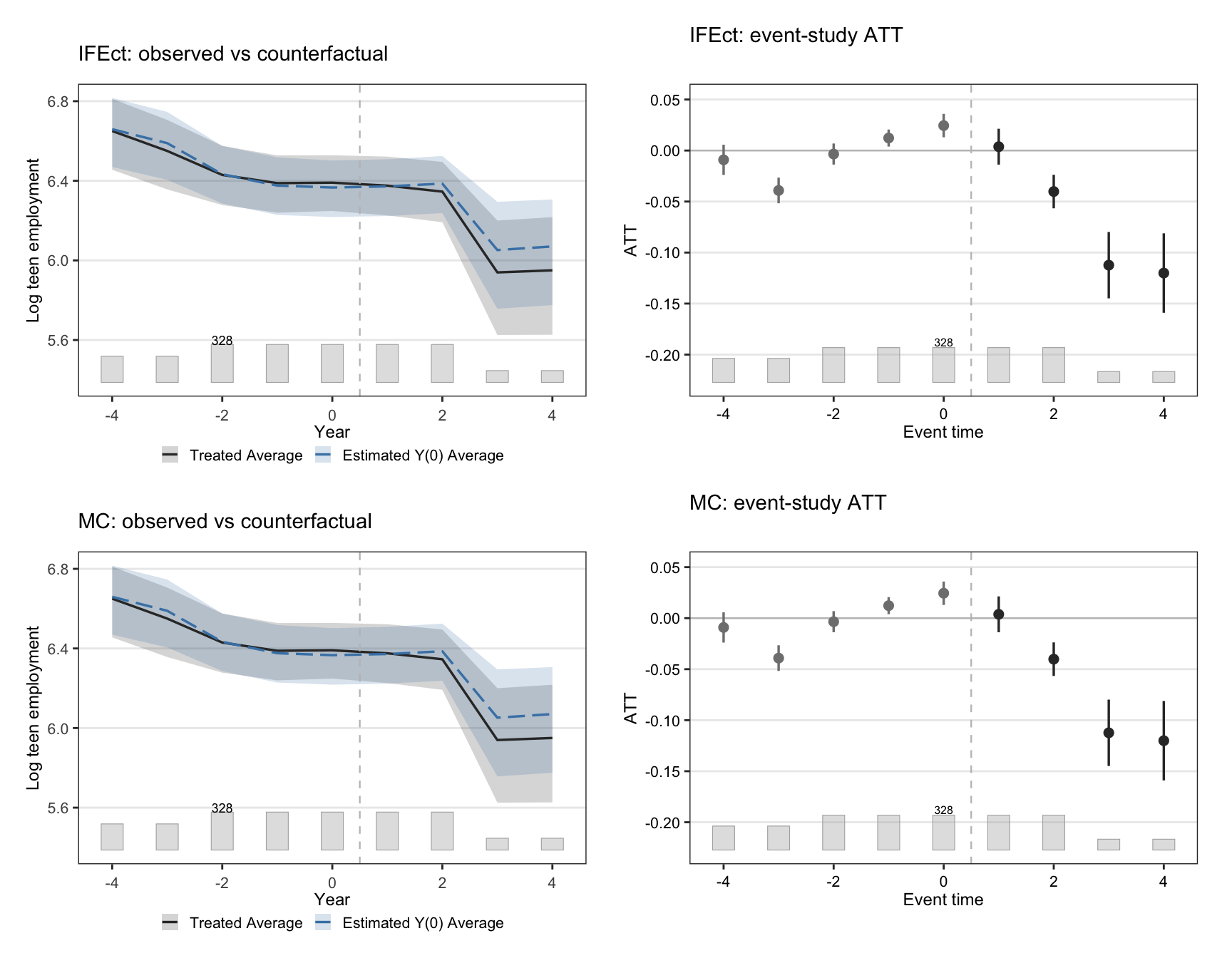
## Counterfactual paths and the ATT trajectory
The signature FECT figure overlays the observed average outcome on
treated units against the model-implied $Y(0)$, then plots the gap
— the ATT path — by event time. A credible factor model should
track the observed $Y$ closely before treatment and only diverge
after.
```{r}
#| label: fig-ife-mc
#| fig-cap: "Counterfactual trajectories and event-study ATT. Top row: IFEct. Bottom row: MC. Left panels overlay observed average outcome on treated units (solid) with model-implied $Y(0)$ (dashed). Right panels show the implied ATT by event time relative to a county's adoption year, with bootstrap 95% CIs."
#| fig-width: 9
#| fig-height: 7
p_ife_ct <- plot(out_ife, type = "counterfactual",
                 main = "IFEct: observed vs counterfactual",
                 xlab = "Year", ylab = "Log teen employment")
p_ife_gap <- plot(out_ife, type = "gap",
                  main = "IFEct: event-study ATT",
                  xlab = "Event time", ylab = "ATT")
p_mc_ct <- plot(out_mc, type = "counterfactual",
                main = "MC: observed vs counterfactual",
                xlab = "Year", ylab = "Log teen employment")
p_mc_gap <- plot(out_mc, type = "gap",
                 main = "MC: event-study ATT",
                 xlab = "Event time", ylab = "ATT")

(p_ife_ct + p_ife_gap) / (p_mc_ct + p_mc_gap)
```
Both estimators reproduce the textbook story: a flat-ish pre-trend
that breaks downward at event time zero. The MC counterfactual is a
touch smoother than IFEct's, which is the regularisation doing its
job.
## F-test for zero pre-trend
The factor structure does not *guarantee* the pre-treatment ATTs
are zero — it only *allows* them to be by absorbing unit-specific
trends. We test the no-anticipation / good-fit assumption directly
with a joint F-test on the pre-treatment ATTs returned by `fect`
(`wald = TRUE` under the hood).
```{r}
#| label: tbl-ftest
#| tbl-cap: "Wald F-test that all pre-treatment ATTs are jointly zero. Large p-values mean the factor structure absorbs pre-trends well; small p-values flag residual pre-trend a single $r$ or $\\lambda$ choice could not iron out."
ftest_row <- function(out, label) {
  tibble(
    Estimator = label,
    `F stat`  = out$test$f.stat,
    df1       = out$test$df1,
    df2       = out$test$df2,
    `p-value` = out$test$f.p
  )
}

bind_rows(
  ftest_row(out_ife, "IFEct"),
  ftest_row(out_mc,  "MC")
) |>
  gt_pretty(decimals = 4)
```
## Side-by-side: CS, IFEct, MC
The punchline. We recompute Callaway-Sant'Anna's overall ATT on
*this same panel* (2001-2007 window) so the three estimates are
directly comparable, then collect them in one table.
```{r}
#| label: cs-fit
#| message: false
#| warning: false
attgt_ch10 <- did::att_gt(
  yname = "lemp", idname = "id", gname = "G", tname = "year",
  data = as.data.frame(mw),
  control_group = "nevertreated",
  base_period   = "universal"
)
cs_overall <- did::aggte(attgt_ch10, type = "group")
```
```{r}
#| label: tbl-compare
#| tbl-cap: "Three estimands, three identifying assumptions, one panel. The Callaway-Sant'Anna row is the chapter 9 estimator recomputed on the 2001-2007 window. IFEct and MC ATTs are FECT's average treatment effect on the treated, averaged across all post-treatment cells."
fect_att <- function(out) {
  list(
    est = out$att.avg,
    se  = out$est.avg[, "S.E."],
    lo  = out$est.avg[, "CI.lower"],
    hi  = out$est.avg[, "CI.upper"]
  )
}
ife <- fect_att(out_ife)
mc  <- fect_att(out_mc)

tibble(
  Estimator = c("Callaway-Sant'Anna overall ATT",
                "IFEct (Xu 2017)",
                "Matrix Completion (Athey et al. 2021)"),
  Estimate  = c(cs_overall$overall.att, ife$est, mc$est),
  SE        = c(cs_overall$overall.se,  ife$se,  mc$se),
  `CI lower` = c(cs_overall$overall.att - 1.96 * cs_overall$overall.se,
                 ife$lo, mc$lo),
  `CI upper` = c(cs_overall$overall.att + 1.96 * cs_overall$overall.se,
                 ife$hi, mc$hi),
  `Identifying assumption` = c(
    "Conditional parallel trends",
    "Linear factor model of Y(0)",
    "Approximately low-rank Y(0)"
  )
) |>
  gt_pretty(decimals = 4)
```
Three estimators that disagree about the assumption point to the
same sign and the same order of magnitude. Quantitatively the CS and
factor-based estimates need not match: CS averages cohort-specific
clean 2×2 contrasts under parallel trends; IFEct and MC impute the
treated cells of a factor model. When they diverge, the gap
quantifies how much of CS's estimate was riding on parallel trends
versus on cohort heterogeneity that a factor model can soak up.
When they agree — as they roughly do here — both assumptions are
consistent with the same conclusion, which is the strongest evidence
a panel design can produce.
::: {.callout-warning appearance="simple"}
**The short-panel caveat.** With $T = 7$ and 3 pre-periods on the
shorter cohort, the rank/penalty selected by cross-validation is
borderline-identifiable. We capped $r \le 2$ deliberately. On a
genuinely short panel ($T \le 5$, which is chapter 9's working
window) IFE and MC become numerically delicate and the F-test loses
power against subtle pre-trend departures. The honest move when the
panel is too short is to *not* run these estimators rather than to
hand-pick a rank. The `fect::simdata` panel in the package ships a
$T = 30$ case that lets you see the methods working at full strength
(see exercise 1).
:::
## Recap
::: {.callout-note appearance="simple"}
**The methods reconciled.** Three answers to the same question on
the 2001-2007 minimum-wage panel:
- *Callaway-Sant'Anna overall ATT*: clean 2×2 contrasts, weighted
to cohort size, under parallel trends.
- *IFEct*: factor model of $Y(0)$ fit on never-treated, imputed on
treated, $r$ chosen by cross-validation.
- *Matrix Completion*: low-rank completion of the masked $Y(0)$
matrix, nuclear-norm penalty $\lambda$ chosen by cross-validation.
All three point downward; all three sit in the same neighbourhood;
none is uniquely correct. The factor-based estimators *relax*
parallel trends rather than replace it, and the F-tests on
pre-treatment ATTs are the quality check for whether that relaxation
bought you anything.
:::
## Common pitfall
Cranking $r$ up until the in-sample fit looks great. With a panel
this short, an IFEct model with $r$ near $T/2$ will fit the pre-
treatment cells almost perfectly *and* produce an absurd
counterfactual on the treated cells, because it has fitted noise
into the loadings. Trust the CV-selected rank and the F-test, not
the eyeballed pre-trend match. The MC equivalent is choosing
$\lambda$ too small; the symptom is the same. Both are over-fitting
masquerading as identification.
## Further reading
The factor-model formulation traces to @bai2009panel; the
generalised synthetic control / IFEct interpretation that powers
`fect`'s implementation is @xu2017generalized. The matrix-completion
view, including theoretical guarantees and the nuclear-norm penalty,
is @athey2021matrix. @liu2024practical is the practical-guide paper
that pairs with the `fect` package and walks through model
diagnostics in depth; its online companion at
<https://yiqingxu.org/packages/fect/04-ife-mc.html> is the
authoritative tutorial.
## Exercises
1. The `fect::simdata` dataset is a $T = 30$ simulated panel with a
known factor structure. Fit IFEct on it with arguments
`CV = TRUE, r = 0:4` and confirm that cross-validation recovers
the true rank. Compare
`out$r.cv` against the simulation's true $r$ (documented in
`?simdata`).
2. Re-fit `out_ife` and `out_mc` on chapter 9's narrower 2003-2007
window. Which estimator degrades more visibly when pre-period
length is cut? Why?
3. Run `fect(..., placeboTest = TRUE, placebo.period = c(-2, -1))`
to hide the last two pre-treatment periods, refit, and check that
the implied ATT on the hidden window is statistically zero. What
does a non-zero placebo result imply about the credibility of the
chapter's headline ATT?