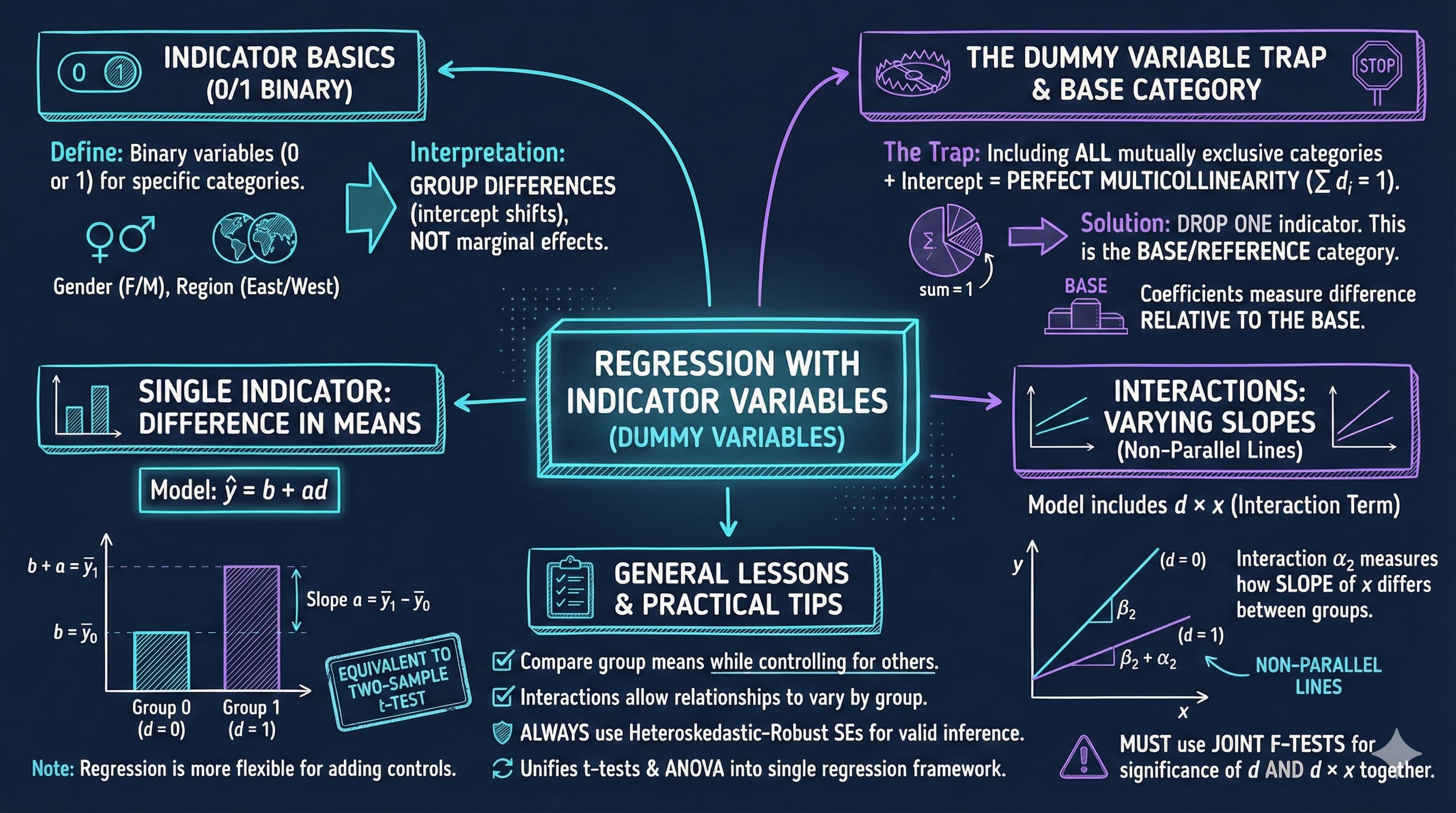
---
title: 14. Regression with Indicator Variables
execute:
enabled: true
warning: false
---
**metricsAI: An Introduction to Econometrics with Python and AI in the Cloud**
*[Carlos Mendez](https://carlos-mendez.org)*
<img src="https://raw.githubusercontent.com/quarcs-lab/metricsai/main/images/ch14_visual_summary.jpg" alt="Chapter 14 Visual Summary" width="100%">
This notebook provides an interactive introduction to regression with indicator variables (also called dummy variables or categorical variables). All code runs directly in Google Colab without any local setup.
[](https://colab.research.google.com/github/quarcs-lab/metricsai/blob/main/notebooks_colab/ch14_Regression_with_Indicator_Variables.ipynb)
<div class="chapter-resources">
<a href="https://www.youtube.com/watch?v=Rkx1cY8_BBY" target="_blank" class="resource-btn">🎬 AI Video</a>
<a href="https://carlos-mendez.my.canva.site/s14-regression-with-indicator-variables-pdf" target="_blank" class="resource-btn">✨ AI Slides</a>
<a href="https://cameron.econ.ucdavis.edu/aed/traedv1_14" target="_blank" class="resource-btn">📊 Cameron Slides</a>
<a href="https://app.edcafe.ai/quizzes/69786a6a2f5d08069e04cf09" target="_blank" class="resource-btn">✏️ Quiz</a>
<a href="https://app.edcafe.ai/chatbots/6978a2782f5d08069e071ecb" target="_blank" class="resource-btn">🤖 AI Tutor</a>
</div>
## Chapter Overview
This chapter focuses on regression analysis when some regressors are indicator variables. Indicator variables are binary (0/1) variables that record whether an observation falls into a particular category.
**What you'll learn:**
- Understand indicator (dummy) variables and their role in regression analysis
- Interpret regression coefficients when regressors are categorical variables
- Use indicator variables to compare group means and test for differences
- Understand the relationship between regression on indicators and t-tests/ANOVA
- Incorporate indicator variables alongside continuous regressors to control for categories
- Create and interpret interaction terms between indicators and continuous variables
- Apply the dummy variable trap rule when using sets of mutually exclusive indicators
- Choose appropriate base categories and interpret coefficients relative to the base
- Conduct joint F-tests for the significance of sets of indicator variables
- Apply indicator variable techniques to real earnings data
**Dataset used:**
- **AED_EARNINGS_COMPLETE.DTA**: 872 full-time workers aged 25-65 in 2000
**Key economic questions:**
- Is there a gender earnings gap? How large is it after controlling for education and experience?
- How do the returns to education differ by gender?
- Do earnings differ across types of workers (self-employed, private, government)?
- Can we test for structural differences between groups?
**Chapter outline:**
- 14.1 Indicator Variables: Single Binary Variable
- 14.2 Indicator Variable with Additional Regressors
- 14.3 Interactions with Indicator Variables
- 14.4 Testing for Structural Change
- 14.5 Sets of Indicator Variables
- Key Takeaways
- Practice Exercises
- Case Studies
## Key Concepts
Six core ideas anchor this chapter. Skim them before you start, and come back when a term feels fuzzy. Each entry pairs a concrete example using the chapter's data with a non-technical analogy. Click a panel to expand it.
**Indicator (Dummy) Variable:** A regressor that takes only two values — usually $1$ when an observation belongs to a category and $0$ when it does not. Adding an indicator to a regression lets the intercept (the predicted $y$) shift cleanly between the two groups, all else equal.
::::: {.columns}
:::: {.column width="50%"}
::: {.callout-tip collapse="true" appearance="simple" title="Example"}
For the 872 workers in `data_earnings`, the variable `gender` is an indicator: $1$ for female, $0$ for male. Regressing `earnings` on `gender` alone yields an intercept of about \$63{,}000 (the male mean) and a coefficient of about $-\$16{,}000$ on `gender` — meaning women earn roughly \$16k less than men, *unconditionally*.
:::
::::
:::: {.column width="50%"}
::: {.callout-note collapse="true" appearance="simple" title="Analogy"}
A light switch has only two states: on or off. An indicator variable encodes the same kind of binary choice for an observation — the lamp's brightness in either state is what the regression equation describes; flipping the switch by including the dummy lets the model show *both* readings on the same fitted line.
:::
::::
:::::
**Base (Reference) Category:** The omitted category in a set of mutually exclusive indicators — the group whose mean the intercept represents. Every coefficient on a remaining indicator measures the *difference* in the outcome between that category and the base. Different choices of base do not change model fit, only interpretation.
::::: {.columns}
:::: {.column width="50%"}
::: {.callout-tip collapse="true" appearance="simple" title="Example"}
For worker type (self-employed, private, government), the chapter fits `earnings ~ dself + dgovt + …` — making **private sector** the base category. The intercept then reads as average private-sector earnings; `dself`'s coefficient is the self-employed–private gap, and `dgovt`'s is the government–private gap. Switching the base to self-employed re-labels the comparisons but leaves $R^2 \approx 0.12$ unchanged.
:::
::::
:::: {.column width="50%"}
::: {.callout-note collapse="true" appearance="simple" title="Analogy"}
A tape measure starts from a zero mark — every reading is a distance *from* zero. The base category is the regression's zero mark for a categorical variable: every other category's coefficient is "how many units above (or below) the base group". Slide the zero mark to a different point on the tape and the readings change — the actual distances do not.
:::
::::
:::::
**Slope Dummy (Interaction with a Continuous Variable):** The product of an indicator and a continuous regressor, written $d \times x$. Adding such a term lets the *slope* on $x$ — not just the intercept — differ between groups. Without the interaction, group lines are parallel; with it, they can have different gradients.
::::: {.columns}
:::: {.column width="50%"}
::: {.callout-tip collapse="true" appearance="simple" title="Example"}
The chapter constructs `genderbyeduc = gender × education` and adds it to the earnings model. The coefficient on `genderbyeduc` measures whether the *return to a year of schooling* differs by gender — precisely the slope-dummy idea. The chapter's joint F-test on all four gender-related terms (`gender`, `genderbyeduc`, `genderbyage`, `genderbyhours`) decisively rejects $H_0$, confirming that gender enters earnings through both intercept and slopes.
:::
::::
:::: {.column width="50%"}
::: {.callout-note collapse="true" appearance="simple" title="Analogy"}
Heating bills depend on hours of furnace use — but the *cost per hour* is higher in winter than summer. A slope dummy would multiply hours-of-use by a winter-indicator to capture exactly that: same equation, different rate per hour. Without it, your bill formula would (wrongly) treat every hour the same year-round.
:::
::::
:::::
**Chow Test:** A formal F-test that compares a *pooled* regression (with one set of coefficients for all observations) to *separate* regressions on each subgroup. Rejecting the null says that pooling is unjustified — at least one slope or intercept differs across groups.
::::: {.columns}
:::: {.column width="50%"}
::: {.callout-tip collapse="true" appearance="simple" title="Example"}
The chapter fits `earnings ~ education + age + hours` separately on the male and female subsamples. Comparing the two female and male coefficient vectors via a Chow F-test directly answers "do men and women have *fundamentally* different earnings equations, or just a constant gap?" — and the chapter's joint F-test on all gender-interactions rejects equality, signalling that the female and male models genuinely diverge.
:::
::::
:::: {.column width="50%"}
::: {.callout-note collapse="true" appearance="simple" title="Analogy"}
A retailer wants to know whether one ad campaign works equally well across stores. They test the campaign in *every* store as one big group (pooled), then split stores by region (separate). The Chow Test is the manager's formal verdict: "is this a single national pattern, or do regions need their own playbooks?"
:::
::::
:::::
**Conditional vs. Unconditional Gap:** The unconditional gap is the raw mean difference between two groups; the conditional gap is the difference *after* including controls in the regression. Most empirical work cares about the conditional gap, since it strips out compositional differences.
::::: {.columns}
:::: {.column width="50%"}
::: {.callout-tip collapse="true" appearance="simple" title="Example"}
The unconditional gender earnings gap on `data_earnings` is about $-\$16{,}000$ — what you get from regressing `earnings` on `gender` alone. Adding `education` does **not** shrink this gap; the conditional coefficient (Model 2) is about $-\$18{,}000$, because women in this sample are more educated on average, so holding education fixed *widens* the unexplained gap. Controls can move a coefficient in either direction.
:::
::::
:::: {.column width="50%"}
::: {.callout-note collapse="true" appearance="simple" title="Analogy"}
A newspaper headline says: "Coastal city pays \$25k more than inland city — proof of cost-of-living premium!" Then the *adjusted* article comes out: once you control for occupation, education, and seniority, only \$8k of the gap remains. The headline figure is unconditional; the article's figure is conditional. Both are real numbers, but they tell very different stories about *why* the gap exists.
:::
::::
:::::
**Pooled vs. Separate Regression:** Two ways to model two groups. The *pooled* fit uses one regression on all data — possibly with group dummies — and forces every slope to be the same across groups. *Separate* regressions fit one model per group, allowing every coefficient to vary. The Chow test arbitrates between the two.
::::: {.columns}
:::: {.column width="50%"}
::: {.callout-tip collapse="true" appearance="simple" title="Example"}
The chapter fits `earnings ~ education + age + hours` in three flavours: pooled across all 872 workers; pooled with full gender interactions (Model 5); and separately on the female and male subsamples. The separate-regression female slope on `education` differs visibly from the male slope — signalling that pooling without interactions would mask group-specific behaviour.
:::
::::
:::: {.column width="50%"}
::: {.callout-note collapse="true" appearance="simple" title="Analogy"}
A pooled regression is the family group photo — everyone in one frame, the camera averages over individual differences. Separate regressions are the *individual* portraits — one of each family member, allowing each face to fill its own frame in its own way. Both have their uses, but if the family members look very different, the group photo can mislead about anyone in particular.
:::
::::
:::::
## Setup
First, we import the necessary Python packages and configure the environment for reproducibility. All data will stream directly from GitHub.
```{python}
#| code-fold: true
#| code-summary: "Setup: Import libraries and configure environment"
# Import required packages
import numpy as np
import pandas as pd
import matplotlib.pyplot as plt
import seaborn as sns
import pyfixest as pf                    # fast OLS estimation
from scipy import stats
from scipy.stats import f_oneway
import random
import os

# Set random seeds for reproducibility
RANDOM_SEED = 42
random.seed(RANDOM_SEED)
np.random.seed(RANDOM_SEED)
os.environ['PYTHONHASHSEED'] = str(RANDOM_SEED)

# GitHub data URL
GITHUB_DATA_URL = "https://raw.githubusercontent.com/quarcs-lab/data-open/master/AED/"

# Set plotting style (dark theme matching book design)
plt.style.use('dark_background')
sns.set_style("darkgrid")
plt.rcParams.update({
    'axes.facecolor': '#1a2235',
    'figure.facecolor': '#12162c',
    'grid.color': '#3a4a6b',
    'figure.figsize': (10, 6),
    'text.color': 'white',
    'axes.labelcolor': 'white',
    'xtick.color': 'white',
    'ytick.color': 'white',
    'axes.edgecolor': '#1a2235',
})

# Chapter 14: Regression With Indicator Variables
# Setup complete! Ready to explore regression with indicator variables.
```
### Data Preparation
We'll work with the earnings dataset which contains information on 872 full-time workers.
**Key variables:**
- **earnings**: Annual earnings in dollars
- **gender**: 1=female, 0=male
- **education**: Years of schooling
- **age**: Age in years
- **hours**: Usual hours worked per week
- **dself**: 1=self-employed, 0=not
- **dprivate**: 1=private sector employee, 0=not
- **dgovt**: 1=government sector employee, 0=not
- **genderbyeduc**: Gender × Education interaction
- **genderbyage**: Gender × Age interaction
- **genderbyhours**: Gender × Hours interaction
```{python}
# Load earnings data
data = pd.read_stata(GITHUB_DATA_URL + 'AED_EARNINGS_COMPLETE.DTA')

print("Data structure:")
print(f"  Observations: {len(data)}")
print(f"  Variables: {len(data.columns)}")

print("\nVariable descriptions:")
variables = ['earnings', 'gender', 'education', 'genderbyeduc', 'age',
             'genderbyage', 'hours', 'genderbyhours', 'dself', 'dprivate', 'dgovt']

for var in variables:
    print(f"  {var}: {data[var].dtype}")

print("\nSummary statistics:")
data[variables].describe()

print("\nNote on indicator variables:")
# gender: 1=female, 0=male
# dself: 1=self-employed, 0=not
# dprivate: 1=private sector, 0=not
# dgovt: 1=government, 0=not
```
## 14.1 Indicator Variables - Single Binary Variable
An **indicator variable** (also called dummy variable or binary variable) takes only two values:
$$d = \begin{cases}
1 & \text{if in the category} \\
0 & \text{otherwise}
\end{cases}$$
### Simple Regression on Single Indicator
When we regress $y$ on just an intercept and an indicator variable:
$$\hat{y} = b + a \cdot d$$
The predicted value takes only two values:
$$\hat{y}_i = \begin{cases}
b + a & \text{if } d_i = 1 \\
b & \text{if } d_i = 0
\end{cases}$$
**Key result**: For OLS regression:
- $b = \bar{y}_0$ (mean of $y$ when $d=0$)
- $a = \bar{y}_1 - \bar{y}_0$ (difference in means)
**Interpretation**: The slope coefficient equals the difference in group means.
### Example: Earnings and Gender
Let's examine whether there's a gender earnings gap.
```{python}
# 14.1: Regression On Single Indicator Variable

# Summary statistics by gender
# Table 14.1: Earnings by Gender

print("\nFemale (gender=1):")
female_stats = data[data['gender'] == 1]['earnings'].describe()
print(female_stats)

print("\nMale (gender=0):")
male_stats = data[data['gender'] == 0]['earnings'].describe()
print(male_stats)

# Calculate means
mean_female = data[data['gender'] == 1]['earnings'].mean()
mean_male = data[data['gender'] == 0]['earnings'].mean()
diff_means = mean_female - mean_male

# Difference in Means
print(f"  Mean earnings (Female): ${mean_female:,.2f}")
print(f"  Mean earnings (Male): ${mean_male:,.2f}")
print(f"  Difference: ${diff_means:,.2f}")
print(f"\n  Interpretation: Females earn ${abs(diff_means):,.2f} less than males on average.")
```
### OLS Regression: Earnings on Gender
Now let's estimate the regression model:
$$\text{earnings} = \beta_1 + \alpha \cdot \text{gender} + u$$
We'll use **heteroskedasticity-robust standard errors** (HC1) for valid inference.
```{python}
# Regression models: Gender and earnings

# Model 1: Gender only
# Model 1: earnings ~ gender
fit1 = pf.feols('earnings ~ gender', data=data, vcov='HC1')

# Key results
intercept_m1 = fit1.coef()['Intercept']
gender_coef  = fit1.coef()['gender']
r2_m1        = fit1._r2

print(f"Estimated equation: earnings = {intercept_m1:,.0f} + ({gender_coef:,.0f}) x gender")
print(f"Gender gap: females earn ${abs(gender_coef):,.0f} less than males on average")
print(f"R-squared: {r2_m1:.4f} ({r2_m1*100:.1f}% of variation explained)")

# Full regression output
fit1.summary()

print(f"\nInterpretation:")
print(f"  Intercept: ${fit1.coef()['Intercept']:,.2f} (mean for males)")
print(f"  Gender coefficient: ${fit1.coef()['gender']:,.2f} (difference for females)")
print(f"  Females earn ${abs(fit1.coef()['gender']):,.2f} less than males on average")
```
> **Key Concept 14.1: Indicator Variables and Difference in Means**
>
> When regressing $y$ on just an intercept and a single indicator $d$, the fitted model is $\hat{y} = b + ad$. The intercept $b$ equals the mean of $y$ when $d=0$, and the slope $a$ equals the difference in means $(\bar{y}_1 - \bar{y}_0)$. Thus, **regression on an indicator variable is equivalent to a difference-in-means test**.
---
### Understanding the Gender Earnings Gap
The regression results reveal a **statistically significant gender earnings gap** of approximately **-\$16,000**. Let's break down what this means:
**Key Findings:**
1. **Intercept ($b_1$) ≈ \$63,000**: This represents the **mean earnings for males** (when gender = 0). We can verify this matches the actual mean earnings for males in the sample.
2. **Gender coefficient ($\alpha$) ≈ -\$16,000**: This is the **difference in mean earnings** between females and males. Specifically:
- Females earn approximately **\$16,000 less** than males on average
- This is the **unconditional (raw) gender gap** - it doesn't account for differences in education, experience, or other factors
3. **Statistical Significance**: The t-statistic is highly significant (p < 0.001), meaning we can confidently reject the null hypothesis that there's no gender difference in earnings.
**Important Interpretation:**
- This regression simply decomposes the sample into two groups and compares their means
- The coefficient on gender equals the difference: $\bar{y}_{female} - \bar{y}_{male}$
- This is a **descriptive** finding, not necessarily **causal** - the gap may reflect differences in education, occupation, hours worked, discrimination, or other factors
- To understand the **adjusted** gender gap (controlling for observable characteristics), we need to add additional regressors
**Connection to t-test:**
- This regression is mathematically equivalent to a two-sample t-test
- The regression framework allows us to easily extend the model by adding control variables
### Comparison with t-test
Regression with a single indicator variable is equivalent to a two-sample t-test.
**Two approaches:**
1. **Welch's t-test** (unequal variances): Similar to regression with robust SEs
2. **Classical t-test** (equal variances): Identical to regression with default SEs
```{python}
# Comparison with t-tests

# Extract earnings by gender
female_earnings = data[data['gender'] == 1]['earnings']
male_earnings = data[data['gender'] == 0]['earnings']

# Welch's t-test (unequal variances)
print("\n1. Welch's t-test (unequal variances):")
t_stat_welch, p_value_welch = stats.ttest_ind(female_earnings, male_earnings, equal_var=False)
print(f"  t-statistic: {t_stat_welch:.4f}")
print(f"  p-value: {p_value_welch:.6f}")
print(f"  Note: Similar to regression with robust SEs")

# Classical t-test (equal variances)
print("\n2. Classical t-test (equal variances):")
t_stat_classical, p_value_classical = stats.ttest_ind(female_earnings, male_earnings, equal_var=True)
print(f"  t-statistic: {t_stat_classical:.4f}")
print(f"  p-value: {p_value_classical:.6f}")

# Regression with default SEs
print("\n3. Regression with default (homoskedastic) SEs:")
fit_gender_default = pf.feols('earnings ~ gender', data=data)
print(f"  t-statistic: {fit_gender_default.tstat()['gender']:.4f}")
print(f"  p-value: {fit_gender_default.pvalue()['gender']:.6f}")
print(f"  Note: IDENTICAL to classical t-test with equal variances")
```
**Key insight:**
- Classical t-test = Regression with default SEs (assuming equal variances)
- Welch's t-test = Regression with robust SEs (allowing unequal variances)
> **Key Concept 14.2: Regression vs. Specialized Test Methods**
>
> Specialized difference-in-means methods (like Welch's t-test) and regression on an indicator give the **same point estimate** but slightly different standard errors. Regression uses $se(\hat{a})$ from the model, while the t-test uses $se(\bar{y}_1 - \bar{y}_0) = \sqrt{s_1^2/n_1 + s_0^2/n_0}$. Both are valid; regression is more flexible when adding control variables.
## 14.2 Indicator Variable with Additional Regressors
The raw difference in earnings by gender may be partly explained by other factors (e.g., education, experience, hours worked).
### Model with Additional Regressors
$$y = \beta_1 + \beta_2 x + \alpha d + u$$
The fitted model:
$$\hat{y}_i = \begin{cases}
b_1 + b_2 x_i + a & \text{if } d_i = 1 \\
b_1 + b_2 x_i & \text{if } d_i = 0
\end{cases}$$
**Interpretation**: The coefficient $a$ measures the difference in $y$ across categories **after controlling** for the additional variables.
### Progressive Model Building
We'll estimate five models of increasing complexity:
1. Gender only
2. Gender + Education
3. Gender + Education + (Gender × Education)
4. Add Age and Hours controls
5. Full interactions with all variables
```{python}
# Progressive Model Building

# Model 2: Gender + Education
# Model 2: earnings ~ gender + education
fit2 = pf.feols('earnings ~ gender + education', data=data, vcov='HC1')
fit2.summary()

# Model 3: Gender + Education + Interaction
# Model 3: earnings ~ gender + education + genderbyeduc
fit3 = pf.feols('earnings ~ gender + education + genderbyeduc', data=data, vcov='HC1')
fit3.summary()

# Model 4: Add Age and Hours
# Model 4: earnings ~ gender + education + genderbyeduc + age + hours
fit4 = pf.feols('earnings ~ gender + education + genderbyeduc + age + hours', data=data, vcov='HC1')
fit4.summary()

# Model 5: Full interactions
fit5 = pf.feols('earnings ~ gender + education + genderbyeduc + age + genderbyage + hours + genderbyhours',
             data=data, vcov='HC1')
fit5.summary()

# Joint F-test for all gender terms
# Joint F-Test: All Gender Terms
# Test joint significance using pyfixest's wald_test
print("Joint F-test for all gender terms:")
print(fit5.wald_test(R=np.eye(len(fit5.coef()))[[list(fit5.coef().index).index(v) for v in ['gender', 'genderbyeduc', 'genderbyage', 'genderbyhours']]]))

# All gender effects (level and interactions) are highly significant.
```
> **Key Concept 14.3: Interaction Terms Between Indicators and Continuous Variables**
>
> An **interacted indicator variable** is the product of an indicator and a continuous regressor, such as $d \times x$. In the model $y = \beta_1 + \beta_2 x + \alpha_1 d + \alpha_2(d \times x) + u$, the coefficient $\alpha_2$ measures how the slope on $x$ differs between groups. Including only $d$ (without interaction) shifts the intercept but keeps slopes parallel. Adding the interaction allows both intercepts and slopes to vary.
---
### How the Gender Gap Changes with Controls
Comparing the five models reveals how the estimated gender gap evolves as we add controls and interactions:
**Model Evolution:**
1. **Model 1 (Gender only)**: Gap = -\$16,000
- This is the **raw, unconditional** gender earnings gap
- Ignores all other factors that might explain earnings differences
2. **Model 2 (+ Education)**: Gap *widens* to approximately -\$18,000
- Adding education as a control **increases** the gender coefficient magnitude by ~\$1,900 (from -\$16,396 to -\$18,258)
- Interpretation: Because women in this sample have *more* education on average, holding education fixed makes the unexplained gap **larger**, not smaller (a suppression effect)
- The -\$18,000 is the gap **conditional on** education
3. **Model 3 (+ Gender × Education)**:
- Now gender enters through **two channels**: the main effect AND the interaction
- The main gender coefficient becomes the gap **when education = 0** (not very meaningful)
- The interaction coefficient shows whether **returns to education differ by gender**
- **Joint F-test is crucial**: Test both coefficients together to assess overall gender effects
4. **Model 4 (+ Age, Hours)**: Further controls
- Adding age and hours worked provides more refined estimates
- These are important determinants of earnings that may differ by gender
- Because the interaction stays in the model, the main gender coefficient remains the (large, positive) gap at *zero* education rather than a shrinking overall gap
5. **Model 5 (Full Interactions)**: Most flexible specification
- Allows gender to affect the **intercept AND slopes** of all variables
- Tests whether returns to education, age, and hours differ by gender
- **Joint F-test on all 4 gender terms** is highly significant
**Key Insights:**
- The gender gap does **not** shrink toward zero when we control for education, age, and hours worked
- Holding education fixed (Model 2) the conditional gap is about -\$18,000; in Models 3-5 gender enters through interactions, so the gap varies with education rather than collapsing to a single small number
- This suggests **observable characteristics explain part, but not all** of the gap
- The remaining gap could reflect:
- Unmeasured factors (experience, occupation, industry)
- Discrimination
- Selection effects (e.g., women choosing lower-paying fields)
**Statistical Lesson:**
- With interactions, **individual t-tests can be misleading** due to multicollinearity
- **Joint F-tests** are essential for testing overall significance of a variable that enters through multiple terms
## 14.3 Interactions with Indicator Variables
An **interacted indicator variable** is the product of an indicator variable and another regressor.
$$y = \beta_1 + \beta_2 x + \alpha_1 d + \alpha_2 (d \times x) + u$$
This allows both intercept AND slope to differ by category:
$$\hat{y} = \begin{cases}
(b_1 + a_1) + (b_2 + a_2) x & \text{if } d = 1 \\
b_1 + b_2 x & \text{if } d = 0
\end{cases}$$
**Interpretation:**
- $a_1$: Difference in intercepts (gender gap at $x=0$)
- $a_2$: Difference in slopes (how returns to $x$ differ by gender)
### Testing Gender Effects
When gender enters through both a level term and interactions, we need **joint F-tests** to test overall significance.
---
### Interpreting Interaction Effects
The interaction term (Gender × Education) captures whether the **returns to education differ by gender**. Let's unpack what the results tell us:
**Model with Interaction (Model 5):**
The full model allows both the intercept and slope to differ by gender:
$$\text{earnings} = \begin{cases}
(\beta_1 + \alpha_1) + (\beta_2 + \alpha_2)\cdot\text{education} + \beta_3\cdot\text{age} + \beta_4\cdot\text{hours} & \text{if female} \\
\beta_1 + \beta_2\cdot\text{education} + \beta_3\cdot\text{age} + \beta_4\cdot\text{hours} & \text{if male}
\end{cases}$$
**Key Coefficients:**
1. **Gender × Education Interaction** (typically negative, around -\$1,000 to -\$2,000):
- **Interpretation**: The return to one additional year of education is approximately **\$1,000-\$2,000 lower for women** than for men
- Example: If $\beta_{education} = 6,000$ and $\beta_{gender \times educ} = -1,500$:
- Males: Each year of education → +\$6,000 in earnings
- Females: Each year of education → +\$4,500 in earnings
- This suggests **women get lower financial returns** from education investments
2. **Gender × Age and Gender × Hours**:
- Similarly capture whether age and hours have different effects by gender
- Allow the **life-cycle earnings profile** to differ by gender
**Avoiding the Dummy Variable Trap:**
Notice we **cannot include all indicators plus an intercept**. In the worker type example:
- We have three categories: self-employed, private, government
- We can only include **two dummy variables** if we have an intercept
- The **omitted category** becomes the reference (base) group
- Coefficients measure differences **relative to the base**
**Which category to omit?**
- Your choice! Results are equivalent no matter which you drop
- Choose the most natural reference category for interpretation
- Example: Private sector is natural base for employment type comparisons
**Joint F-Test Results:**
The joint F-tests show that:
- All gender effects together are **highly statistically significant** (F ≈ 20-40, p < 0.001)
- Even though individual coefficients may have large standard errors (multicollinearity)
- Gender matters for **both level and slope** of earnings relationships
### Model Comparison Table
Let's create a comprehensive comparison of all five models.
```{python}
# Summary table of all models
# Summary Table: All Five Models

summary_df = pd.DataFrame({
    'Model 1': ['Gender only', fit1.coef().get('gender', np.nan),
                fit1.se().get('gender', np.nan), fit1.tstat().get('gender', np.nan),
                fit1._N, fit1._r2, fit1._adj_r2, np.sqrt(np.mean(fit1._u_hat**2))],
    'Model 2': ['+ Education', fit2.coef().get('gender', np.nan),
                fit2.se().get('gender', np.nan), fit2.tstat().get('gender', np.nan),
                fit2._N, fit2._r2, fit2._adj_r2, np.sqrt(np.mean(fit2._u_hat**2))],
    'Model 3': ['+ Gender×Educ', fit3.coef().get('gender', np.nan),
                fit3.se().get('gender', np.nan), fit3.tstat().get('gender', np.nan),
                fit3._N, fit3._r2, fit3._adj_r2, np.sqrt(np.mean(fit3._u_hat**2))],
    'Model 4': ['+ Age, Hours', fit4.coef().get('gender', np.nan),
                fit4.se().get('gender', np.nan), fit4.tstat().get('gender', np.nan),
                fit4._N, fit4._r2, fit4._adj_r2, np.sqrt(np.mean(fit4._u_hat**2))],
    'Model 5': ['Full Interact', fit5.coef().get('gender', np.nan),
                fit5.se().get('gender', np.nan), fit5.tstat().get('gender', np.nan),
                fit5._N, fit5._r2, fit5._adj_r2, np.sqrt(np.mean(fit5._u_hat**2))]
}, index=['Description', 'Gender Coef', 'Robust SE', 't-stat', 'N', 'R²', 'Adj R²', 'RMSE'])

summary_df.to_string()
```
**Key observations from the model comparison:**
- Gender coefficient magnitude changes as we add controls
- R-squared increases with additional variables
- Interactions capture differential effects across groups
> **Key Concept 14.4: Joint Significance Testing for Indicator Variables**
>
> When an indicator and its interaction with another variable are both included, test their **joint significance** using an F-test rather than individual t-tests. The joint test $H_0: \alpha_1 = 0, \alpha_2 = 0$ evaluates whether the categorical variable matters at all. Individual t-tests can be misleading when the indicator and interaction are correlated.
## 14.4 Testing for Structural Change - Separate Regressions
An alternative to including interactions is to estimate **separate regressions** for each group.
**Female regression:**
$$\text{earnings}_i = \beta_1^F + \beta_2^F \text{education}_i + \beta_3^F \text{age}_i + \beta_4^F \text{hours}_i + u_i$$
**Male regression:**
$$\text{earnings}_i = \beta_1^M + \beta_2^M \text{education}_i + \beta_3^M \text{age}_i + \beta_4^M \text{hours}_i + u_i$$
This allows ALL coefficients to differ by gender, not just those we interact.
### Chow Test
The **Chow test** formally tests whether coefficients differ across groups:
$$H_0: \beta^F = \beta^M \text{ (pooled model)} \quad \text{vs.} \quad H_a: \beta^F \neq \beta^M \text{ (separate models)}$$
```{python}
# 14.4: TESTING FOR STRUCTURAL CHANGE

print("\nSeparate Regressions by Gender")

# Female regression
fit_female = pf.feols('earnings ~ education + age + hours',
                   data=data[data['gender'] == 1], vcov='HC1')
print("\nFemale subsample:")
print(f"  N = {int(fit_female._N)}")
print(f"  Intercept: {fit_female.coef()['Intercept']:,.2f}")
print(f"  Education: {fit_female.coef()['education']:,.2f}")
print(f"  Age: {fit_female.coef()['age']:,.2f}")
print(f"  Hours: {fit_female.coef()['hours']:,.2f}")
print(f"  R²: {fit_female._r2:.4f}")

# Male regression
fit_male = pf.feols('earnings ~ education + age + hours',
                 data=data[data['gender'] == 0], vcov='HC1')
print("\nMale subsample:")
print(f"  N = {int(fit_male._N)}")
print(f"  Intercept: {fit_male.coef()['Intercept']:,.2f}")
print(f"  Education: {fit_male.coef()['education']:,.2f}")
print(f"  Age: {fit_male.coef()['age']:,.2f}")
print(f"  Hours: {fit_male.coef()['hours']:,.2f}")
print(f"  R²: {fit_male._r2:.4f}")

# Compare coefficients
# Comparison of Coefficients

comparison = pd.DataFrame({
    'Female': fit_female.coef(),
    'Male': fit_male.coef(),
    'Difference': fit_female.coef() - fit_male.coef()
})
print(comparison)

print("\nKey findings:")
print(f"  - Returns to education: ${fit_female.coef()['education']:,.0f} (F) vs ${fit_male.coef()['education']:,.0f} (M)")
print(f"  - Returns to age: ${fit_female.coef()['age']:,.0f} (F) vs ${fit_male.coef()['age']:,.0f} (M)")
print(f"  - Returns to hours: ${fit_female.coef()['hours']:,.0f} (F) vs ${fit_male.coef()['hours']:,.0f} (M)")
```
Comparing the two subsamples shows that the returns to education and to hours are noticeably larger for men than for women (about \$6,300 vs \$4,200 per year of schooling, and about \$1,600 vs \$700 per weekly hour), while the return to age is similar across genders. This pattern — different *slopes*, not just a constant intercept gap — is exactly what a formal Chow test is designed to detect.
> **Key Concept 14.5: Testing for Structural Change**
>
> Running **separate regressions** for each group allows all coefficients to differ simultaneously. The **Chow test** evaluates whether pooling the data (imposing the same coefficients for both groups) is justified. If the F-test rejects the null, the relationship between $y$ and $x$ differs fundamentally across groups -- not just in intercept or one slope, but throughout the model.
## 14.5 Sets of Indicator Variables (Multiple Categories)
Often we have categorical variables with **more than two categories**.
**Example: Type of Worker**
- Self-employed (dself = 1)
- Private sector employee (dprivate = 1)
- Government employee (dgovt = 1)
These are **mutually exclusive**: each person falls into exactly one category.
### The Dummy Variable Trap
Since the three indicators sum to 1 ($d1 + d2 + d3 = 1$), we **cannot include all three plus an intercept**.
**Solution**: Drop one indicator (the **reference category** or **base category**).
The coefficient of an included indicator measures the difference relative to the base category.
### Three Equivalent Approaches
1. **Include intercept, drop one indicator** (most common)
2. **Drop intercept, include all indicators** (coefficients = group means)
3. **Change which indicator is dropped** (changes interpretation, not fit)
```{python}
# Sets of indicator variables: Worker type

# Approach 1: Include intercept, drop one indicator (dprivate as reference)
# Approach 1: Intercept + dself + dgovt (dprivate is reference)
fit_worker1 = pf.feols('earnings ~ dself + dgovt + education + age', data=data, vcov='HC1')
fit_worker1.summary()

# Approach 2: Drop intercept, include all indicators
# Approach 2: No intercept + all dummies (dself + dprivate + dgovt)
fit_worker2 = pf.feols('earnings ~ dself + dprivate + dgovt + education + age - 1', data=data, vcov='HC1')
fit_worker2.summary()

# Approach 3: Different reference category (dself as reference)
# Approach 3: Intercept + dprivate + dgovt (dself is reference)
fit_worker3 = pf.feols('earnings ~ dprivate + dgovt + education + age', data=data, vcov='HC1')
fit_worker3.summary()

# Key Insight:
print(f"  All three models have IDENTICAL R²: {fit_worker1._r2:.4f}")
print(f"  Only the interpretation changes (different reference category)")
print(f"  Fitted values and residuals are the same across all three")
```
> **Key Concept 14.6: The Dummy Variable Trap**
>
> The **dummy variable trap** occurs when including all $C$ indicators from a set of mutually exclusive categories plus an intercept. Since $d_1 + d_2 + \cdots + d_C = 1$, this creates **perfect multicollinearity** -- the intercept is an exact linear combination of the indicators. **Solution**: Drop one indicator (the "base category") or drop the intercept. Standard practice is to keep the intercept and drop one indicator.
---
### Understanding the Dummy Variable Trap
The results above demonstrate a **fundamental principle** in regression with categorical variables:
**The Dummy Variable Trap Explained:**
When we have $k$ mutually exclusive categories (e.g., 3 worker types), we face perfect multicollinearity:
$$d_{self} + d_{private} + d_{govt} = 1 \text{ (for every observation)}$$
This means one dummy is a **perfect linear combination** of the others plus the constant!
**Three Equivalent Solutions:**
1. **Include intercept, drop one dummy** (Standard approach)
- Intercept = mean for the omitted (reference) category
- Each coefficient = difference from reference category
- Most common and easiest to interpret
2. **Drop intercept, include all dummies** (No-constant model)
- Each coefficient = mean for that category
- No reference category needed
- Useful when you want group means directly
3. **Change which dummy is dropped** (Different reference)
- All three models have **identical fit** (same R², predictions, residuals)
- Only interpretation changes (different reference group)
- Choose based on what comparison is most meaningful
**Empirical Results from Worker Type Example:**
From the three specifications above:
- **R² is identical** across all specifications (≈ 0.12)
- **Joint F-tests** give the same result (testing if worker type matters)
- Only the individual coefficients change (but they measure different things)
**Example Interpretation:**
If reference = Private sector:
- $d_{self}$ coefficient ≈ +\$17,000: Self-employed earn about \$17,000 *more* than private sector (self-employed are the highest earners in this sample)
- $d_{govt}$ coefficient ≈ -\$2,000: Government workers earn about \$2,000 *less* than private sector
If reference = Self-employed:
- $d_{private}$ coefficient ≈ -\$17,000: Private sector earns about \$17,000 *less* than self-employed
- $d_{govt}$ coefficient ≈ -\$19,000: Government workers earn about \$19,000 *less* than self-employed
Notice: The government-vs-private gap is the same in both parameterizations (≈ -\$2,000)!
**Practical Advice:**
- Choose the **largest or most common** category as reference
- Or choose the **policy-relevant** comparison (e.g., treatment vs. control)
- Always clearly state which category is omitted
- Report joint F-test for overall significance of the categorical variable
### ANOVA: Testing Equality of Means Across Groups
**Analysis of Variance (ANOVA)** tests whether means differ across multiple groups.
$$H_0: \mu_1 = \mu_2 = \mu_3 \quad \text{vs.} \quad H_a: \text{at least one mean differs}$$
ANOVA is equivalent to an F-test in regression with indicator variables.
```{python}
# ANOVA: Testing Equality of Means Across Worker Types

# Create categorical variable for worker type
data['typeworker'] = (1 * data['dself'] + 2 * data['dprivate'] + 3 * data['dgovt']).astype(int)

print("\nMeans by worker type:")
means_by_type = data.groupby('typeworker')['earnings'].agg(['mean', 'std', 'count'])
means_by_type.index = ['Self-employed', 'Private', 'Government']
print(means_by_type)

# One-way ANOVA using scipy
# One-way ANOVA (scipy)

group1 = data[data['typeworker'] == 1]['earnings']
group2 = data[data['typeworker'] == 2]['earnings']
group3 = data[data['typeworker'] == 3]['earnings']

f_stat_anova, p_value_anova = f_oneway(group1, group2, group3)

print(f"  F-statistic: {f_stat_anova:.2f}")
print(f"  p-value: {p_value_anova:.6f}")

if p_value_anova < 0.05:
    print(f"\n  Result: Reject H₀ - Earnings differ significantly across worker types")
else:
    print(f"\n  Result: Fail to reject H₀ - No significant difference in earnings")

# ANOVA as regression on indicators

fit_anova = pf.feols('earnings ~ C(typeworker)', data=data)
fit_anova.summary()

print("\nNote: ANOVA F-statistic matches the joint test from regression")
```
> **Key Concept 14.7: ANOVA as Regression on Indicators**
>
> Regressing $y$ on a set of mutually exclusive indicators (with no other controls) is equivalent to **analysis of variance (ANOVA)**. Coefficients give group means or differences from the base mean. The regression F-test for joint significance of the indicators is identical to the ANOVA F-statistic, testing whether the categorical variable explains significant variation in $y$.
### Visualizations
Let's create informative visualizations to illustrate our findings.
```{python}
# VISUALIZATIONS

# Figure 1: Earnings by gender and worker type
fig, axes = plt.subplots(1, 2, figsize=(14, 6))

# Panel 1: Box plot by gender
data['Gender'] = data['gender'].map({0: 'Male', 1: 'Female'})
sns.boxplot(x='Gender', y='earnings', data=data, ax=axes[0], palette='Set2')
axes[0].set_ylabel('Earnings ($)', fontsize=12)
axes[0].set_xlabel('Gender', fontsize=12)
axes[0].set_title('Earnings Distribution by Gender', fontsize=13, fontweight='bold')
axes[0].grid(True, alpha=0.3, axis='y')

# Add mean markers
means_gender = data.groupby('Gender')['earnings'].mean()
axes[0].scatter([0, 1], means_gender.values, color='red', s=100, zorder=5, marker='D', label='Mean')
axes[0].legend()

# Panel 2: Box plot by worker type
data['Worker Type'] = data['typeworker'].map({1: 'Self-employed', 2: 'Private', 3: 'Government'})
sns.boxplot(x='Worker Type', y='earnings', data=data, ax=axes[1], palette='Set1')
axes[1].set_ylabel('Earnings ($)', fontsize=12)
axes[1].set_xlabel('Worker Type', fontsize=12)
axes[1].set_title('Earnings Distribution by Worker Type', fontsize=13, fontweight='bold')
axes[1].tick_params(axis='x', rotation=20)
axes[1].grid(True, alpha=0.3, axis='y')

# Add mean markers
means_type = data.groupby('Worker Type')['earnings'].mean()
axes[1].scatter([0, 1, 2], means_type.values, color='red', s=100, zorder=5, marker='D', label='Mean')
axes[1].legend()

plt.tight_layout()
plt.show()
```
**What to look for in these box plots:**
- **Medians**: The horizontal lines inside each box show the typical earnings for each group
- **Spread**: Wider boxes and longer whiskers indicate greater earnings variation within a group
- **Outliers**: Points beyond the whiskers represent unusually high earners
- **Red diamonds**: Mean markers may differ from medians, indicating skewness in the earnings distribution
Next, we plot earnings against years of education separately for men and women, fitting a regression line to each group. Watch whether the two lines are parallel or have visibly different slopes — non-parallel lines are the visual signature of an interaction effect.
```{python}
# Figure 2: Earnings vs education by gender (with regression lines)
fig, ax = plt.subplots(figsize=(11, 7))

for gender, label, color in [(0, 'Male', '#22d3ee'), (1, 'Female', 'red')]:
    subset = data[data['gender'] == gender]
    ax.scatter(subset['education'], subset['earnings'], alpha=0.4, label=label,
               s=30, color=color)

    # Add regression line
    z = np.polyfit(subset['education'], subset['earnings'], 1)
    p = np.poly1d(z)
    edu_range = np.linspace(subset['education'].min(), subset['education'].max(), 100)
    ax.plot(edu_range, p(edu_range), linewidth=3, color=color,
            label=f'{label} (slope={z[0]:,.0f})')

ax.set_xlabel('Years of Education', fontsize=13)
ax.set_ylabel('Earnings ($)', fontsize=13)
ax.set_title('Figure 14.2: Earnings vs Education by Gender\n(Different slopes suggest interaction effects)',
             fontsize=14, fontweight='bold')
ax.legend(fontsize=11, loc='upper left')
ax.grid(True, alpha=0.3)
plt.tight_layout()
plt.show()
```
**What to look for in this scatter plot:**
- **Slopes**: The different slopes indicate that returns to education vary by gender
- **Implication**: Non-parallel lines justify including the gender x education interaction term
- **Gap**: The vertical distance between lines shows the gender earnings gap at each education level
> **Key Concept 14.8: Visualizing Group Differences in Regression**
>
> Scatter plots with **separate regression lines** by group visually reveal whether slopes and intercepts differ. Parallel lines indicate only an intercept shift (indicator without interaction), while non-parallel lines indicate differential slopes (interaction term needed). Box plots complement this by showing the distribution of $y$ across categories.
## Key Takeaways
### Indicator Variables Basics
- **Indicator variables** (dummy variables) are binary variables that equal 1 if an observation is in a specific category and 0 otherwise
- They allow regression models to incorporate categorical information such as gender, employment type, or region
- Interpretation differs from continuous variables -- coefficients represent **group differences** rather than marginal effects
### Regression on a Single Indicator and Difference in Means
- When regressing $y$ on just an intercept and a single indicator $d$, the fitted model is $\hat{y} = b + ad$
- The intercept $b$ equals the mean of $y$ when $d=0$ (the reference group)
- The slope $a$ equals the **difference in means**: $a = \bar{y}_1 - \bar{y}_0$
- Regression on an indicator is mathematically equivalent to a two-sample difference-in-means test
- Regression and specialized t-tests give the same estimate but slightly different standard errors
- Example: Women earn \$16,396 less than men on average ($t = -4.71$, highly significant)
### Indicators with Controls and Interaction Terms
- Adding an indicator to a regression with continuous variables measures the group difference **after controlling for** other factors
- Including only the indicator shifts the intercept but keeps slopes **parallel** across groups
- An **interaction term** $d \times x$ allows slopes to differ by group (non-parallel lines)
- The interaction coefficient measures how the effect of $x$ on $y$ differs between groups
- Always use **joint F-tests** to test significance of both the indicator and its interaction together
### Dummy Variable Trap and Base Category
- The **dummy variable trap** occurs when including all $C$ indicators from a mutually exclusive set plus an intercept
- Since $d_1 + d_2 + \cdots + d_C = 1$, this creates perfect multicollinearity
- **Solution**: Drop one indicator (the "base category") or drop the intercept
- The **base category** is the reference group -- coefficients on included indicators measure differences from the base
- Choice of base category does not affect statistical conclusions, only interpretation
### Hypothesis Testing with Indicator Sets
- A **t-test on a single indicator** tests whether that category differs from the base category
- An **F-test on all $C-1$ included indicators** tests whether the categorical variable matters overall
- The F-test result is the same regardless of which category is dropped (invariant to base choice)
- Regressing $y$ on mutually exclusive indicators without controls is equivalent to **ANOVA**
- Always use F-tests to evaluate the overall significance of a categorical variable
### General Lessons
- Indicator variables unify many statistical tests (t-tests, ANOVA) in a single regression framework
- Always use heteroskedastic-robust standard errors for valid inference
- Interactions with continuous variables allow relationships to vary by group
- Regression flexibility: add controls, test interactions, compare models -- all within one framework
**Python Libraries and Code:**
This single code block reproduces the core workflow of Chapter 14. It is self-contained — copy it into an empty notebook and run it to review the complete pipeline from indicator variable regression to interaction effects, the dummy variable trap, and ANOVA.
```python
# =============================================================================
# CHAPTER 14 CHEAT SHEET: Regression with Indicator Variables
# =============================================================================

# --- Libraries ---
import pandas as pd                       # data loading and manipulation
import numpy as np                        # numerical operations
import matplotlib.pyplot as plt           # creating plots and visualizations
import pyfixest as pf                     # fast OLS estimation
# !pip install pyfixest
from scipy import stats                   # t-tests for group comparisons
from scipy.stats import f_oneway          # one-way ANOVA F-test

# =============================================================================
# STEP 1: Load data directly from a URL
# =============================================================================
# pd.read_stata() reads Stata .dta files — 872 full-time workers aged 25-65
url = "https://raw.githubusercontent.com/quarcs-lab/data-open/master/AED/AED_EARNINGS_COMPLETE.DTA"
data = pd.read_stata(url)

print(f"Dataset: {data.shape[0]} observations, {data.shape[1]} variables")

# =============================================================================
# STEP 2: Descriptive statistics — compare earnings by gender
# =============================================================================
# Indicator variable: gender = 1 (female), gender = 0 (male)
mean_male   = data[data['gender'] == 0]['earnings'].mean()
mean_female = data[data['gender'] == 1]['earnings'].mean()
diff_means  = mean_female - mean_male

print(f"Mean earnings (Male):   ${mean_male:,.2f}")
print(f"Mean earnings (Female): ${mean_female:,.2f}")
print(f"Difference (F - M):     ${diff_means:,.2f}")

# =============================================================================
# STEP 3: Regression on a single indicator — equivalent to difference in means
# =============================================================================
# The intercept = mean for d=0 (males); the gender coefficient = mean difference
# pf.feols with vcov='HC1' uses robust standard errors
fit1 = pf.feols('earnings ~ gender', data=data, vcov='HC1')

intercept = fit1.coef()['Intercept']    # mean earnings for males
gap       = fit1.coef()['gender']       # earnings gap (females - males)
r2        = fit1._r2

print(f"\nModel 1: earnings = {intercept:,.0f} + ({gap:,.0f}) × gender")
print(f"Raw gender gap: ${gap:,.0f} (females earn ${abs(gap):,.0f} less)")
print(f"R-squared: {r2:.4f} ({r2*100:.1f}% of variation explained)")

fit1.summary()

# =============================================================================
# STEP 4: Add controls and interaction — how the gap changes
# =============================================================================
# Adding education as a control measures the gap AFTER accounting for education
fit2 = pf.feols('earnings ~ gender + education', data=data, vcov='HC1')

# Adding gender×education interaction allows returns to education to differ by gender
fit3 = pf.feols('earnings ~ gender + education + genderbyeduc', data=data, vcov='HC1')

# Full model with additional controls
fit4 = pf.feols('earnings ~ gender + education + genderbyeduc + age + hours',
             data=data, vcov='HC1')

# Compare how the gender coefficient evolves across models
print(f"{'Model':<12} {'Gender Coef':>14} {'R²':>8}")
print("-" * 36)
for name, m in [('Gender only', fit1), ('+ Education', fit2),
                ('+ Interact', fit3), ('+ Age,Hours', fit4)]:
    g = m.coef()['gender']
    print(f"{name:<12} {g:>14,.0f} {m._r2:>8.4f}")

# =============================================================================
# STEP 5: Scatter plot — visualize separate regression lines by gender
# =============================================================================
# Non-parallel lines indicate different slopes = interaction term is needed
fig, ax = plt.subplots(figsize=(10, 6))

for g, label, color in [(0, 'Male', 'tab:blue'), (1, 'Female', 'tab:red')]:
    subset = data[data['gender'] == g]
    ax.scatter(subset['education'], subset['earnings'], alpha=0.3, s=25,
               label=label, color=color)
    # Fit and plot regression line for each group
    z = np.polyfit(subset['education'], subset['earnings'], 1)
    edu_range = np.linspace(subset['education'].min(), subset['education'].max(), 100)
    ax.plot(edu_range, np.poly1d(z)(edu_range), linewidth=2, color=color,
            label=f'{label} slope: ${z[0]:,.0f}/yr')

ax.set_xlabel('Years of Education')
ax.set_ylabel('Earnings ($)')
ax.set_title('Earnings vs Education by Gender (non-parallel = interaction needed)')
ax.legend()
ax.grid(True, alpha=0.3)
plt.tight_layout()
plt.show()

# =============================================================================
# STEP 6: Sets of indicators — worker type and the dummy variable trap
# =============================================================================
# Three mutually exclusive categories: dself, dprivate, dgovt (sum to 1)
# Drop one (dprivate = base) to avoid perfect multicollinearity
fit_worker = pf.feols('earnings ~ dself + dgovt + education + age',
                   data=data, vcov='HC1')

print(f"Base category: Private sector")
print(f"Self-employed vs Private: ${fit_worker.coef()['dself']:,.0f}")
print(f"Government vs Private:   ${fit_worker.coef()['dgovt']:,.0f}")
print(f"R-squared: {fit_worker._r2:.4f}")

fit_worker.summary()

# =============================================================================
# STEP 7: ANOVA — test if earnings differ across worker types
# =============================================================================
# Regression on mutually exclusive indicators = analysis of variance (ANOVA)
group_self = data[data['dself'] == 1]['earnings']
group_priv = data[data['dprivate'] == 1]['earnings']
group_govt = data[data['dgovt'] == 1]['earnings']

f_stat, p_value = f_oneway(group_self, group_priv, group_govt)
print(f"\nANOVA F-statistic: {f_stat:.2f}, p-value: {p_value:.4f}")

# Group means with counts
data['worker_type'] = np.where(data['dself'] == 1, 'Self-employed',
                      np.where(data['dprivate'] == 1, 'Private', 'Government'))
print(data.groupby('worker_type')['earnings'].agg(['mean', 'count']).round(0))
```
**Try it yourself!** Copy this code into an empty Google Colab notebook and run it: [Open Colab](https://colab.research.google.com/notebooks/empty.ipynb)
---
**Next Steps:**
- **Chapter 15:** Regression with Transformed Variables
- **Chapter 16:** Model Diagnostics
---
**Congratulations!** You've completed Chapter 14. You now understand how to incorporate categorical variables into regression analysis, interpret indicator coefficients, test for group differences, and use interactions to model differential effects across categories.
> **Common Mistakes to Avoid**
>
> - **Falling into the dummy variable trap**: Always omit one category as the reference group
> - **Misinterpreting the reference category**: Coefficients show differences FROM the omitted group
> - **Forgetting that interaction terms change the interpretation of main effects**
## Practice Exercises
**Exercise 1: Interpreting Indicator Regression**
OLS regression of $y$ on an intercept and indicator $d$ using all data yields $\hat{y} = 3 + 5d$.
**(a)** What is $\bar{y}$ for the subsample with $d = 0$?
**(b)** What is $\bar{y}$ for the subsample with $d = 1$?
**(c)** What does the coefficient 5 represent?
---
**Exercise 2: Constructing from Means**
Suppose $\bar{y} = 30$ for the subsample with $d = 1$ and $\bar{y} = 20$ for the subsample with $d = 0$.
**(a)** Give the fitted model from OLS regression of $y$ on an intercept and $d$ using the full sample.
**(b)** Is the difference in means statistically significant? What additional information would you need?
---
**Exercise 3: Multiple Indicators**
We have three mutually exclusive indicator variables $d_1$, $d_2$, and $d_3$. OLS yields $\hat{y} = 1 + 3d_2 + 5d_3$.
**(a)** What is the estimated mean of $y$ for each category?
**(b)** What is the estimated difference between category 2 ($d_2 = 1$) and category 1 ($d_1 = 1$)?
**(c)** Which category is the base (omitted) category?
---
**Exercise 4: Changing Base Category**
For the model in Exercise 3, give the coefficient estimates if instead we regressed $y$ on an intercept, $d_1$, and $d_2$ (dropping $d_3$ instead of $d_1$).
---
**Exercise 5: Interaction Interpretation**
A regression of earnings on education, gender, and their interaction yields:
$$\widehat{\text{earnings}} = 10{,}000 + 5{,}000 \times \text{education} - 8{,}000 \times \text{gender} - 2{,}000 \times (\text{gender} \times \text{education})$$
where gender = 1 for female, 0 for male.
**(a)** Write the fitted equation for males and for females separately.
**(b)** What is the returns to education for males? For females?
**(c)** At what education level does the gender earnings gap equal zero?
---
**Exercise 6: Joint F-Test**
A researcher includes a gender indicator and a gender-education interaction in a regression. The t-statistic on the gender indicator is $t = -1.5$ (not significant at 5%) and the t-statistic on the interaction is $t = -1.8$ (not significant at 5%).
**(a)** Can we conclude that gender does not matter for earnings? Why or why not?
**(b)** What test should we conduct instead? What would you expect to find?
**(c)** Explain why individual t-tests can be misleading when testing the significance of indicator variables with interactions.
## Case Studies
### Case Study 1: Regional Indicator Variables for Cross-Country Productivity
In this case study, you will apply indicator variable techniques to analyze how labor productivity differs across world regions and whether the determinants of productivity vary by region.
**Dataset:** Mendez Convergence Clubs
```python
import pandas as pd
url = "https://raw.githubusercontent.com/quarcs-lab/mendez2020-convergence-clubs-code-data/master/assets/dat.csv"
dat = pd.read_csv(url)
dat2014 = dat[dat['year'] == 2014].copy()
```
**Variables:** `lp` (labor productivity), `kl` (physical capital per worker), `h` (human capital), `region` (world region)
---
#### Task 1: Create Regional Indicators and Compute Means (Guided)
Create indicator variables for each region and compute mean log productivity by region.
```python
# Create indicator variables from the region column
region_dummies = pd.get_dummies(dat2014['region'], prefix='region', drop_first=False)
dat2014 = pd.concat([dat2014, region_dummies], axis=1)

# Compute mean log productivity by region
import numpy as np
dat2014['ln_lp'] = np.log(dat2014['lp'])
print(dat2014.groupby('region')['ln_lp'].agg(['mean', 'count']))
```
**Questions:** How many regions are there? Which region has the highest average productivity? The lowest?
---
#### Task 2: Regression on Regional Indicators (Guided)
Regress log productivity on regional indicators (using one region as the base category).
```python
import pyfixest as pf
fit1 = pf.feols('ln_lp ~ C(region)', data=dat2014, vcov='HC1')
fit1.summary()
```
**Questions:** Which region is the base category? How do you interpret the coefficients? Are the regional differences statistically significant?
> **Key Concept 14.9: Regional Indicators as Difference in Means**
>
> When regressing $y$ on a set of regional indicators without controls, each coefficient measures the **difference in mean** $y$ between that region and the base region. The F-test for joint significance tests whether there are any significant productivity differences across regions.
---
#### Task 3: Add Continuous Controls (Semi-guided)
Add physical capital and human capital as continuous controls. Observe how regional coefficients change.
**Hints:**
- Use `ln_lp ~ C(region) + np.log(kl) + h` as the formula
- Compare regional coefficients with and without controls
- What does it mean when regional gaps shrink after adding controls?
---
#### Task 4: Regional Interactions (Semi-guided)
Add an interaction between region and human capital to test whether the returns to human capital differ by region.
**Hints:**
- Use `ln_lp ~ C(region) * h + np.log(kl)` to include all region-human-capital interactions
- How do you interpret the interaction coefficients?
- Do the returns to human capital differ significantly across regions?
> **Key Concept 14.10: Interaction Terms for Regional Heterogeneity**
>
> Interaction terms between regional indicators and continuous variables allow the **slope** of a regressor to differ by region. A significant interaction indicates that the effect of human capital (or physical capital) on productivity is not uniform across all regions -- some regions benefit more from the same increase in inputs.
---
#### Task 5: Joint F-Tests for Regional Effects (Independent)
Conduct joint F-tests to evaluate:
- Whether regional indicators are jointly significant (with and without controls)
- Whether the regional interaction terms are jointly significant
- Compare the explanatory power of models with and without regional effects
---
#### Task 6: Policy Brief on Regional Disparities (Independent)
Write a 200-300 word brief addressing:
- How large are regional productivity differences?
- How much of the gap is explained by differences in physical and human capital?
- Do the returns to human capital differ by region, and what are the policy implications?
- What additional factors might explain remaining regional differences?
---
**What You've Learned:** You have applied indicator variable techniques to cross-country data, demonstrating that regional indicators capture systematic productivity differences that partially reflect differences in factor endowments. Interaction terms reveal that the returns to human capital vary across regions, with important implications for development policy.
### Case Study 2: Urban-Rural and Regional Divides in Bolivian Development
In previous chapters, we estimated satellite-development regressions treating all Bolivian municipalities identically. But Bolivia's nine departments span diverse geographies---from Andean highlands to Amazonian lowlands. In this case study, we apply Chapter 14's **indicator variable** techniques to model regional differences in development levels and in the satellite-development relationship.
**Research Question**: Do development levels and the NTL-development relationship differ across Bolivia's nine departments?
**Dataset:** DS4Bolivia
```python
import pandas as pd
url_bol = "https://raw.githubusercontent.com/quarcs-lab/ds4bolivia/master/ds4bolivia_v20250523.csv"
bol = pd.read_csv(url_bol)
```
**Key variables:** `mun` (municipality), `dep` (department), `imds` (Municipal Development Index, 0--100), `ln_NTLpc2017` (log nighttime lights per capita)
#### Task 1: Create Indicators and Group Means (Guided)
**Objective**: Create department indicator variables and compare mean development across departments.
**Instructions**:
1. Load the DS4Bolivia dataset and select key variables
2. Use `pd.get_dummies(bol['dep'])` to create department indicators
3. Compute mean `imds` by department with `groupby('dep')['imds'].agg(['mean', 'count'])`
4. Which department has the highest mean IMDS? The lowest?
Run the code below to get started.
```{python}
# Load DS4Bolivia dataset
url_bol = "https://raw.githubusercontent.com/quarcs-lab/ds4bolivia/master/ds4bolivia_v20250523.csv"
bol = pd.read_csv(url_bol)

# Select key variables
bol_key = bol[['mun', 'dep', 'imds', 'ln_NTLpc2017']].dropna().copy()

# Ds4Bolivia: Department Indicators And Group Means
print(f"Observations: {len(bol_key)} municipalities")
print(f"Departments: {bol_key['dep'].nunique()}")

# Create department indicator variables
dep_dummies = pd.get_dummies(bol_key['dep'])
print(f"\nIndicator variables created: {list(dep_dummies.columns)}")

# Mean IMDS by department
dept_stats = bol_key.groupby('dep')['imds'].agg(['mean', 'count']).sort_values('mean', ascending=False)
dept_stats.round(2)

print(f"\nHighest mean IMDS: {dept_stats['mean'].idxmax()} ({dept_stats['mean'].max():.2f})")
print(f"Lowest mean IMDS:  {dept_stats['mean'].idxmin()} ({dept_stats['mean'].min():.2f})")
```
#### Task 2: Regression on Department Indicators (Guided)
**Objective**: Regress IMDS on department indicators to quantify regional development differences.
**Instructions**:
1. Estimate `imds ~ C(dep)` using pyfixest --- `C()` creates dummies automatically
2. Print the regression summary
3. Interpret: Each coefficient is the difference from the **base category** (the omitted department)
4. What is the base department? How much higher or lower is each department relative to the base?
```python
fit_dep = pf.feols('imds ~ C(dep)', data=bol_key, vcov='HC1')
fit_dep.summary()
```
```{python}
# Your code here: Regression of IMDS on department indicators
#
# Steps:
# 1. Estimate model: imds ~ C(dep)
# 2. Print summary
# 3. Identify the base department and interpret coefficients
#
# fit_dep = pf.feols('imds ~ C(dep)', data=bol_key, vcov='HC1')
# print(fit_dep.summary())
#
# print(f"\nBase department: {sorted(bol_key['dep'].unique())[0]}")
# print(f"Intercept = mean IMDS for the base department: {fit_dep.coef()['Intercept']:.2f}")
```
> **Key Concept 14.11: Geographic Indicator Variables**
>
> Department indicators capture **time-invariant regional characteristics** that affect development: altitude, climate, proximity to borders, historical infrastructure investments, and cultural factors. By including department dummies, we control for these systematic regional differences, allowing us to estimate the NTL-development relationship *within* departments rather than across them. The coefficient on NTL then reflects how NTL variation within a department predicts development variation within that department.
#### Task 3: Add NTL Control (Semi-guided)
**Objective**: Compare department coefficients with and without the NTL control variable.
**Instructions**:
1. Estimate `imds ~ C(dep) + ln_NTLpc2017`
2. Compare department coefficients with those from Task 2 (without NTL)
3. Do department differences shrink when NTL is added?
4. What does this tell us about whether NTL explains part of the regional gap?
**Hints**:
- If department coefficients shrink, it means part of the regional gap was due to differences in NTL intensity
- If they remain large, departments differ for reasons beyond what NTL captures
```{python}
# Your code here: Add NTL as a continuous control
#
# Steps:
# 1. Estimate: imds ~ C(dep) + ln_NTLpc2017
# 2. Compare department coefficients with Task 2 results
# 3. Interpret changes
#
# fit_dep_ntl = pf.feols('imds ~ C(dep) + ln_NTLpc2017', data=bol_key, vcov='HC1')
# print(fit_dep_ntl.summary())
#
# print("\nComparison: Do department coefficients shrink with NTL control?")
# print("If yes, NTL explains part of the regional development gap.")
```
#### Task 4: Interaction Terms (Semi-guided)
**Objective**: Test whether the NTL-development slope differs across departments.
**Instructions**:
1. Estimate `imds ~ C(dep) * ln_NTLpc2017` (includes main effects + interactions)
2. Which interaction terms are significant?
3. Interpret: The NTL slope differs by department
4. In which departments does NTL predict development more or less strongly?
**Hints**:
- `C(dep) * ln_NTLpc2017` automatically includes both main effects and all interactions
- A positive interaction means the NTL slope is steeper in that department compared to the base
- A negative interaction means the NTL slope is flatter
```{python}
# Your code here: Interaction between department and NTL
#
# Steps:
# 1. Estimate: imds ~ C(dep) * ln_NTLpc2017
# 2. Examine interaction coefficients
# 3. Identify departments where NTL effect is stronger/weaker
#
# fit_interact = pf.feols('imds ~ C(dep) * ln_NTLpc2017', data=bol_key, vcov='HC1')
# print(fit_interact.summary())
#
# print("\nInterpretation:")
# print("  Significant interactions indicate the NTL slope differs by department.")
# print("  Base department NTL slope = coefficient on ln_NTLpc2017")
# print("  Other departments: base slope + interaction coefficient")
```
> **Key Concept 14.12: Heterogeneous Satellite Effects**
>
> Interaction terms between department indicators and NTL allow the **slope of the NTL-development relationship** to differ across regions. This is economically meaningful: in highly urbanized departments (like La Paz or Cochabamba), additional nighttime lights may signal commercial activity, while in rural highland departments (like Potosi), lights primarily reflect basic electrification. A significant interaction indicates that the *economic meaning* of satellite signals varies by geographic context.
#### Task 5: Joint F-Test for Department Effects (Independent)
**Objective**: Test the joint significance of all department indicators and all interaction terms.
**Instructions**:
1. Test joint significance of all department indicators using an F-test
2. Also test joint significance of all interaction terms
3. Are regional differences significant? Do NTL effects significantly vary across regions?
**Hints**:
- Use the fitted model's `wald_test()` method or compare restricted vs. unrestricted models
- For interaction terms, compare the model with interactions to the model without
- Report F-statistics and p-values for both tests
```{python}
# Your code here: Joint F-tests for department effects
#
# Steps:
# 1. F-test for joint significance of department indicators
# 2. F-test for joint significance of interaction terms
# 3. Compare models with and without regional effects
#
# Approach: fit the models, then use pyfixest's wald_test() (as in Section 14.3)
#           to jointly test the relevant sets of coefficients.
# fit_dep_only = pf.feols('imds ~ C(dep) + ln_NTLpc2017', data=bol_key)
# fit_full = pf.feols('imds ~ C(dep) * ln_NTLpc2017', data=bol_key)
#
# # 1. Joint test of all department indicators
# dep_terms = [c for c in fit_dep_only.coef().index if c.startswith('C(dep)')]
# R_dep = np.eye(len(fit_dep_only.coef()))[[list(fit_dep_only.coef().index).index(v) for v in dep_terms]]
# print("Joint F-test: department indicators")
# print(fit_dep_only.wald_test(R=R_dep))
#
# # 2. Joint test of all department x NTL interaction terms
# int_terms = [c for c in fit_full.coef().index if ':' in c]
# R_int = np.eye(len(fit_full.coef()))[[list(fit_full.coef().index).index(v) for v in int_terms]]
# print("\nJoint F-test: department x NTL interactions")
# print(fit_full.wald_test(R=R_int))
```
#### Task 6: Regional Disparities Brief (Independent)
**Objective**: Write a 200--300 word brief on regional development disparities in Bolivia.
**Your brief should address**:
1. What are the main regional divides in Bolivian development?
2. How much do department indicators explain beyond NTL?
3. Does the satellite-development relationship differ across regions?
4. What are the policy implications for targeted regional interventions?
**Use evidence from your analysis**: Cite specific coefficients, R-squared values, and F-test results to support your arguments.
```{python}
# Your code here: Additional analysis for the policy brief
#
# You might want to:
# 1. Create a summary table comparing R-squared across models
# 2. Visualize department means with confidence intervals
# 3. Plot separate NTL-IMDS regression lines by department
# 4. Calculate specific statistics to cite in your brief
#
# Example: Compare model fit
# print("MODEL COMPARISON")
# print(f"  NTL only:        R² = {fit_base._r2:.4f}")
# print(f"  + Dept dummies:  R² = {fit_dep_only._r2:.4f}")
# print(f"  + Interactions:  R² = {fit_full._r2:.4f}")
```
#### What You've Learned from This Case Study
Through this analysis of regional development disparities in Bolivia, you have applied Chapter 14's indicator variable techniques to a real geospatial dataset:
- **Indicator variable creation**: Used `pd.get_dummies()` and `C()` to create department dummies
- **Department dummies in regression**: Quantified development differences across Bolivia's nine departments
- **Controlling for regional effects**: Compared models with and without department indicators to assess how much of the NTL-development relationship reflects regional composition
- **Interaction terms**: Tested whether the satellite-development slope differs across departments
- **Joint F-tests**: Evaluated the overall significance of department effects and interaction terms
- **Policy interpretation**: Connected statistical findings to regional development policy
**Connection to next chapter**: In Chapter 15, we explore *nonlinear* satellite-development relationships using log transformations, polynomials, and elasticities.
---
**Well done!** You've now analyzed both cross-country productivity data and Bolivian municipal development data using indicator variable techniques, demonstrating how geographic dummies capture systematic regional differences and how interactions reveal heterogeneous effects.